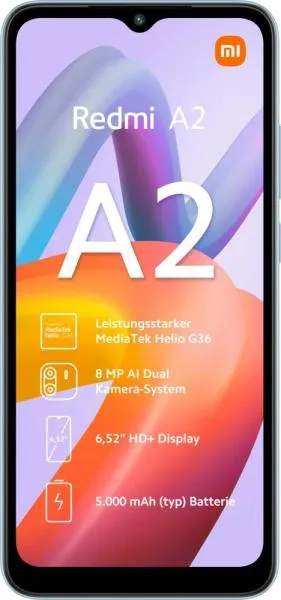

1. Specifications Comparison
| Feature | Xiaomi Redmi A2+ | Samsung Galaxy M55 | Practical Impact |
|---|---|---|---|
| Design | |||
| Dimensions (mm) | 164.9 x 76.8 x 9.1 | 163.9 x 76.5 x 7.8 | M55 slightly smaller and thinner |
| Weight (g) | 192 | 180 | M55 noticeably lighter |
| Build | Not specified | Not specified | Build quality comparison not possible |
| Display | |||
| Display Type | IPS LCD | Super AMOLED | M55 offers significantly better contrast, colors, and viewing angles |
| Size (inches) | 6.52 | 6.7 | M55 has a slightly larger screen |
| Resolution | 720 x 1600 | 1080 x 2400 | M55 boasts much sharper visuals |
| Refresh Rate | Not specified | 120Hz | M55 provides smoother scrolling and animations |
| Brightness | 400 nits (typ) | 1000 nits (HBM) | M55 significantly brighter, enhancing outdoor visibility |
| Performance | |||
| Chipset | Mediatek Helio G36 (12 nm) | Qualcomm Snapdragon 7 Gen 1 (4 nm) | M55 significantly faster and more power-efficient |
| CPU | Octa-core (4x2.2 GHz Cortex-A53 & 4x1.7 GHz Cortex-A53) | Octa-core (1x2.4 GHz Cortex-A710 & 3x2.36 GHz Cortex-A710 & 4x1.8 GHz Cortex-A510) | M55 offers vastly superior CPU performance for demanding tasks and multitasking |
| GPU | PowerVR GE8320 | Adreno 644 | M55 provides a substantially better gaming and graphics experience |
| RAM | 2GB/3GB | 8GB | M55 allows for seamless multitasking and app switching |
| Storage | 32GB/64GB | 256GB | M55 offers much more storage space for apps, media, and files |
| Camera | |||
| Rear Camera | 8MP + 0.3MP | 50MP + 8MP + 2MP | M55 provides significantly higher resolution and versatility with ultrawide and macro lenses |
| Front Camera | 5MP | 50MP | M55 allows for much higher resolution selfies |
| Video Recording | 1080p@30fps | 4K@30fps | M55 offers superior video recording capabilities |
| Battery | |||
| Capacity | 5000 mAh | 5000 mAh | Similar battery capacity |
| Fast Charging | 10W | 45W | M55 charges significantly faster |
2. Key Differences Analysis
Xiaomi Redmi A2+ Advantages:
- Lower Price: Significantly more affordable.
Samsung Galaxy M55 Advantages:
- Superior Performance: Significantly faster processor, more RAM, and better GPU for smoother operation, multitasking, and gaming.
- Better Display: Higher resolution, AMOLED technology, higher refresh rate, and brightness for a vastly improved visual experience.
- Enhanced Camera System: Higher resolution sensors, versatile lens options (ultrawide, macro), and better video recording capabilities.
- Faster Charging: 45W fast charging significantly reduces charging time compared to 10W.
- More Storage: Offers significantly more storage space for apps and files.
- NFC: Enables contactless payments and other NFC functionalities.
- More up-to-date OS: Ships with Android 14, offering newer features and potentially longer software support.
3. User Profiles & Recommendations
Xiaomi Redmi A2+: Budget-conscious users who prioritize basic communication and light internet browsing. Ideal for:
- Basic phone users: Calling, texting, and occasional social media use.
- Students: Limited budget and basic smartphone needs.
- Elderly users: Simple interface and essential functionalities.
Samsung Galaxy M55: Users who value performance, display quality, camera capabilities, and faster charging. Ideal for:
- Power users: Demanding tasks, multitasking, and gaming.
- Photography enthusiasts: Capturing high-quality photos and videos.
- Content consumers: Enjoying media on a vibrant display.
4. Decision Framework
Key Questions for Buyers:
- What is your budget? The Redmi A2+ is significantly cheaper.
- What are your primary smartphone usage patterns? Basic tasks vs. demanding applications.
- Which features are most important to you? Performance, display, camera, or battery life.
My Choice: Samsung Galaxy M55
While the Redmi A2+ offers an extremely budget-friendly option, the Samsung Galaxy M55 provides significantly better value in the long run. The superior performance, display, camera, and faster charging dramatically enhance the overall user experience. The higher initial cost is justified by the long-term benefits of a smoother, more enjoyable, and feature-rich smartphone experience. Even though specific build materials aren't listed for either phone, Samsung generally has better quality control than Xiaomi, leading to a potentially more durable device. The M55's up-to-date OS also promises longer software updates and better security in the long run. For a moderate increase in price, the M55 provides a substantial leap in functionality and quality.
