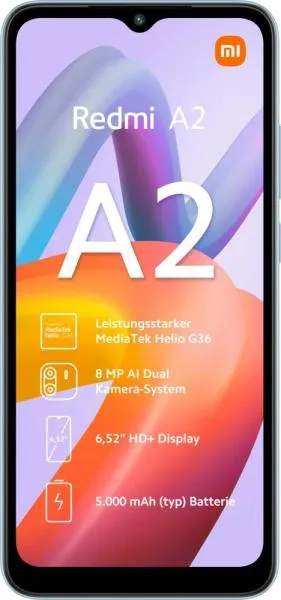

1. Specifications Comparison
| Feature | Xiaomi Redmi A2+ | Motorola Moto G35 | Practical Impact |
|---|---|---|---|
| Design | |||
| Dimensions (mm) | 164.9 x 76.8 x 9.1 | 166.3 x 76 x 7.8 | Moto G35 is slightly larger but thinner. Negligible difference in daily use. |
| Weight (g) | 192 | 188 | Moto G35 is slightly lighter, but the difference is minimal. |
| Build | Unspecified | Unspecified | Build quality cannot be compared due to lack of information. |
| Display | |||
| Size (inches) | 6.52 | 6.72 | Moto G35 offers a slightly larger screen for more immersive media consumption. |
| Resolution | 720 x 1600 | 1080 x 2400 | Moto G35 has a significantly sharper and clearer display. Text, images, and videos will look much better. |
| Display Type | IPS LCD | IPS LCD | Both use IPS LCD technology. |
| Refresh Rate | Unspecified | 120Hz | Moto G35's 120Hz refresh rate provides smoother scrolling and animations, resulting in a more responsive and fluid user experience. |
| Peak Brightness | 400 nits (typ) | 1000 nits (peak) | Moto G35 will be much more readable in direct sunlight. |
| Performance | |||
| Chipset | Mediatek Helio G36 (12 nm) | Unisoc T760 (6 nm) | Moto G35's Unisoc T760, built on a smaller 6nm process, offers significant performance and efficiency advantages over the Helio G36. |
| CPU | Octa-core (4x2.2 GHz Cortex-A53 & 4x1.7 GHz Cortex-A53) | Octa-core (1x2.2 GHz Cortex-A76 & 3x Cortex-A76 & 4x Cortex-A55) | Moto G35 boasts a more powerful CPU architecture with Cortex-A76 cores, enabling faster multitasking and smoother performance in demanding applications. |
| GPU | PowerVR GE8320 | Mali-G57 | Moto G35's Mali-G57 GPU offers better gaming performance and graphics rendering compared to the PowerVR GE8320. |
| RAM | 2GB | 8GB | Moto G35 offers significantly more RAM, enabling smoother multitasking and preventing apps from closing in the background. |
| Camera | |||
| Rear Camera | 8MP + 0.3MP | 50MP + 8MP | Moto G35 has a substantially better rear camera setup with a higher resolution primary sensor and a dedicated wide-angle lens, leading to improved image quality and versatility. |
| Front Camera | 5MP | 16MP | Moto G35's front camera offers a much higher resolution for better selfies and video calls. |
| Video Recording | 1080p@30fps | 4K@30fps, 1080p@30fps | Moto G35 can record video at a higher resolution (4K) offering more detail. |
| Battery | |||
| Capacity | 5000 mAh | 5000 mAh | Both phones have the same battery capacity. |
| Charging | 10W | 18W | Moto G35 supports faster charging, reducing downtime. |
2. Key Differences Analysis
Motorola Moto G35 Advantages:
- Significantly better performance: The more modern and powerful chipset, combined with more RAM, translates to a much smoother and responsive user experience.
- Superior display: Higher resolution, refresh rate, and peak brightness contribute to a more enjoyable viewing experience.
- Enhanced camera system: Higher resolution sensors, wide-angle lens, and 4K video recording capabilities offer significant improvements in image and video quality.
- Faster charging: Reduces downtime.
- NFC for contactless payments: Adds convenience for mobile payments and other NFC applications.
Xiaomi Redmi A2+ Advantages:
- Lower price: Caters to budget-conscious buyers.
3. User Profiles & Recommendations
Xiaomi Redmi A2+: Suitable for users with very basic needs like calling, texting, and light web browsing. Its low price makes it accessible to those on a tight budget.
Motorola Moto G35: Ideal for users who prioritize performance, display quality, and camera capabilities. Suitable for gaming, media consumption, and photography enthusiasts. Good value for its price range.
4. Decision Framework
Key Questions for Buyers:
- What is your budget? The Redmi A2+ is significantly cheaper.
- What are your primary use cases? For basic tasks, the A2+ might suffice. For demanding tasks, gaming, or photography, the Moto G35 is vastly superior.
- How important is display quality and performance? The Moto G35 offers a substantially better experience in these areas.
Scenario-Based Recommendations:
- Tight Budget, Basic Usage: Redmi A2+
- Balanced Budget, Everyday Use: Moto G35
- Gaming, Photography Enthusiast: Moto G35
My Choice: Motorola Moto G35
While the Xiaomi Redmi A2+ offers an extremely low price point, the Motorola Moto G35 provides a significantly better overall user experience due to its superior performance, display, camera, and faster charging. The price difference is justified by the substantial upgrades across the board. The Moto G35 offers better value in the long run due to its more future-proof specifications. For the average user, the smoother performance, better screen, and enhanced camera of the Moto G35 will make a noticeable difference in daily usage.
