
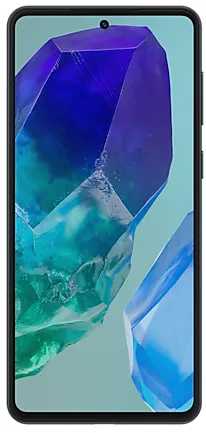
1. Specifications Comparison
| Feature | Samsung Galaxy A14 | Samsung Galaxy M55 | Practical Impact |
|---|---|---|---|
| Design | |||
| Dimensions (mm) | 167.7 x 78 x 9.1 | 163.9 x 76.5 x 7.8 | M55 is slightly smaller and thinner, making it potentially more pocketable. |
| Weight (g) | 201 | 180 | M55 is noticeably lighter, improving one-handed use and reducing fatigue. |
| Display | |||
| Size (inches) | 6.6 | 6.7 | Negligible difference in screen real estate. |
| Resolution (px) | 1080 x 2408 | 1080 x 2400 | Virtually identical sharpness. |
| Type | PLS LCD | Super AMOLED+ | M55 offers significantly better contrast, colors, and viewing angles due to AMOLED technology. Its 120Hz refresh rate will result in smoother animations and scrolling compared to the A14's unspecified refresh rate (likely 60Hz). |
| Refresh Rate (Hz) | Unspecified | 120 | M55's 120Hz provides a smoother and more responsive user experience. |
| Performance | |||
| Chipset | Mediatek Helio G80 (12nm) | Qualcomm Snapdragon 7 Gen 1 (4nm) | M55 boasts a significantly more powerful and efficient processor, leading to much faster performance in demanding tasks, smoother multitasking, and better battery life. |
| CPU | Octa-core (2x2.0 GHz Cortex-A75 & 6x1.8 GHz Cortex-A55) | Octa-core (1x2.4 GHz Cortex-A710 & 3x2.36 GHz Cortex-A710 & 4x1.8 GHz Cortex-A510) | M55's CPU architecture is newer and more powerful. |
| GPU | Mali-G52 MC2 | Adreno 644 | M55 offers significantly better graphics performance for gaming and other visually demanding applications. |
| RAM (GB) | 4 | 8 | M55 has double the RAM, enabling better multitasking and smoother performance with multiple apps open. |
| Camera | |||
| Main Camera (MP) | 50 | 50 | Resolution is similar, but image quality will likely differ due to sensor and processing differences. M55 also has Optical Image Stabilization (OIS) for sharper photos and videos in low light or when moving. |
| Front Camera (MP) | 13 | 50 | M55 has a much higher resolution front camera for significantly better selfies. |
| Video Recording | 1080p@30fps | 4K@30fps with OIS, EIS | M55 offers much higher video resolution and stabilization, resulting in significantly better video quality. |
| Battery | |||
| Capacity (mAh) | 5000 | 5000 | Similar battery capacity. However, real-world battery life will depend on usage and the M55's more efficient processor could provide longer usage. |
| Fast Charging | 15W | 45W | M55 supports significantly faster charging, minimizing downtime. |
2. Key Differences Analysis
Samsung Galaxy A14 Advantages:
- Lower Price: Expected to be significantly cheaper.
Samsung Galaxy M55 Advantages:
- Superior Performance: Significantly faster processor, GPU, and more RAM.
- Better Display: AMOLED technology with a 120Hz refresh rate provides a more vibrant and smooth visual experience.
- Enhanced Camera: Higher resolution front camera, 4K video recording, and Optical Image Stabilization (OIS) for better photo and video quality.
- Faster Charging: 45W fast charging significantly reduces charging time.
3. User Profiles & Recommendations
Samsung Galaxy A14:
- Budget-conscious users: For users prioritizing affordability over high-end features.
- Basic smartphone users: Suitable for calling, texting, web browsing, and light social media use.
Samsung Galaxy M55:
- Performance-focused users: Ideal for gamers, power users, and those who demand smooth multitasking.
- Multimedia enthusiasts: Excellent for consuming media, capturing high-quality photos and videos, and enjoying a premium visual experience.
4. Decision Framework
Key Questions for Buyers:
- What is your budget? The A14 is likely a much more affordable option.
- What are your primary smartphone uses? For basic tasks, the A14 might suffice. For demanding applications and multimedia, the M55 is superior.
- How important is display quality and smoothness? The M55's AMOLED display with a 120Hz refresh rate is a major advantage.
My Choice: Samsung Galaxy M55
While the Samsung Galaxy A14 offers a budget-friendly option, the Samsung Galaxy M55 is the clear winner for me. The significantly improved performance, superior display, enhanced camera capabilities, and faster charging outweigh the price difference. The Snapdragon 7 Gen 1, coupled with 8GB of RAM and a 120Hz AMOLED display, promises a fluid and enjoyable user experience. The investment in the M55 would likely provide a more future-proof and satisfying smartphone experience in the long run. The superior camera features, especially OIS, are also crucial for capturing high-quality photos and videos. While price is a factor, the performance and feature gap between the two phones is substantial enough to justify choosing the M55.
