P4R 5G
Overview
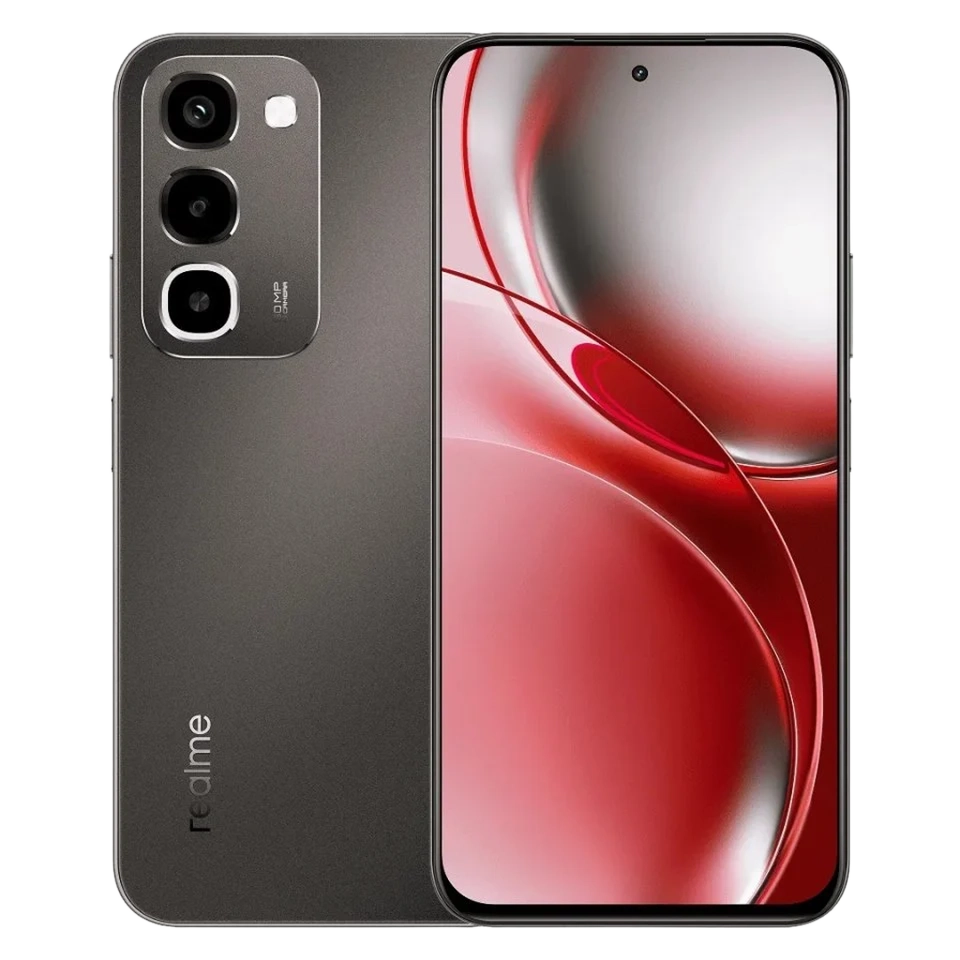
The P4R 5G is a 2026 smartphone from Realme. It features a 6.8" AMOLED display with 729 x 1570 px resolution (255 ppi pixel density), offering a smooth 144 Hz refresh rate, protected by Corning Gorilla Glass 7i. The device is powered by the MediaTek Dimensity 6300 (6 nm process), 4GB LPDDR4X RAM RAM and Arm Mali-G57 MC2 GPU. Power is provided by a 8000 mAh Li-Ion Polymer battery with 45W fast charging. The phone runs on Android 16. Available in multiple configurations: 4GB RAM + 128GB storage, 6GB RAM + 128GB storage, 6GB RAM + 256GB storage.
P4R 5G Review
P4R 5G Review: A Battery-First 5G Phone With Some Sharp Trade-Offs
The P4R 5G looks built around one headline promise: endurance. An 8,000 mAh battery, efficient 6 nm MediaTek chip, 45 W charging, and a low-resolution AMOLED display suggest a phone that should last a very long time between charges. But that same spec sheet also reveals meaningful compromises: it is heavy, the screen is large but not very sharp, NFC is missing, camera information is thin, and the base 4 GB RAM version may feel limited over time.
This is not a spec-sheet “flagship killer.” It reads more like a practical, budget-to-lower-midrange 5G phone aimed at people who care more about battery life, media consumption, and everyday reliability than premium photography or high-end gaming.
1. Specifications Overview
Design
| Feature | Specification | Practical Impact |
|---|---|---|
| Size | 166.4 × 78.2 × 8.8 mm | This is a large phone. It should be comfortable for videos and reading, but one-handed use will be difficult for many people. |
| Weight | 224 g | Heavier than many mainstream phones. The big battery is the likely reason, but you will feel this in a pocket or during long one-handed sessions. |
| Build protection | Corning Gorilla Glass 7i / Panda glass listed | The display should have decent scratch/drop resistance for the tier, though real durability also depends on frame design and case use. The spec sheet lists both Gorilla Glass 7i and Panda glass, which is slightly unclear. |
| Fingerprint sensor | Under-display fingerprint | Convenient and cleaner-looking than a side-mounted sensor, though speed and reliability need hands-on testing. |
| Colors | Not specified | No judgment possible on finish options or whether it offers more subtle or bold designs. |
Display
| Feature | Specification | Practical Impact |
|---|---|---|
| Screen size | 6.8-inch AMOLED | Excellent size for watching video, browsing, maps, and reading. AMOLED should deliver deep blacks and strong contrast. |
| Resolution | 729 × 1570 pixels | This is low for a 6.8-inch screen. Text, icons, and fine details may look softer than on typical Full HD+ phones. |
| Pixel density | 255 ppi | Usable, but not crisp by modern standards. If you are sensitive to screen sharpness, this is one of the biggest compromises. |
| Refresh rate | 1–144 Hz | Scrolling and animations can feel very smooth, and the variable range may help save power when high refresh is not needed. However, using 144 Hz constantly can still increase battery drain. |
| Touch sampling | 240 Hz | Good for responsiveness in everyday use and casual gaming, though serious competitive gamers may still want a stronger GPU. |
| Typical brightness | 600 nits | Fine indoors and usable outdoors, but not class-leading. Since no peak brightness is listed, harsh sunlight performance is uncertain. |
| HDR | HDR10+ | HDR support is nice for compatible video, but the relatively low resolution and unknown peak brightness may limit the “wow” factor. |
| Color | DCI-P3, 10-bit panel | Should allow rich color and smoother gradients, especially in video and wallpapers. Calibration quality still depends on software tuning. |
| Notch style | Hole-punch | Modern look and less intrusive than an old-style notch. |
Performance
| Feature | Specification | Practical Impact |
|---|---|---|
| Chipset | MediaTek Dimensity 6300 | A capable efficiency-focused 5G chip for everyday tasks, social apps, streaming, navigation, and light-to-moderate gaming. Not a flagship-class processor. |
| CPU | 2× Cortex-A76 at 2.4 GHz + 6× Cortex-A55 at 2.0 GHz | The two performance cores help with app launches and bursts of speed; the six efficiency cores help battery life during lighter tasks. |
| Process | 6 nm | Generally good for power efficiency, especially paired with the large battery and low-resolution display. |
| GPU | Mali-G57 MC2 | Fine for casual games, but demanding titles will likely need reduced graphics settings for stable performance. |
| RAM | 4 GB base; 6 GB variants available | The 4 GB version may feel tight on Android 16, especially with multitasking. The 6 GB model is the safer choice. |
| Storage | 128 GB or 256 GB UFS 2.2 | UFS 2.2 is a plus at this level: apps and files should load faster than on cheaper eMMC storage. |
| microSD slot | Yes | Useful if you store lots of videos, music, or offline maps. Especially helpful on the 128 GB model. |
| Cooling system | Yes | Encouraging for longer gaming or hotspot sessions, but thermal performance cannot be confirmed from specs alone. |
| AnTuTu | 675,000 v11 | Suggests solid midrange-style benchmark performance, but benchmarks do not guarantee long-term smoothness or gaming stability. |
| OS | Android 16 | Modern software out of the box. Update policy is not listed, so long-term support is unknown. |
Camera
| Feature | Specification | Practical Impact |
|---|---|---|
| Selfie camera | 8 MP, f/2.0 CMOS | Should be adequate for video calls and basic selfies, but likely not impressive in dim lighting. |
| Rear camera info | 2 MP black-and-white sensor listed | A 2 MP monochrome sensor is typically auxiliary, not a main camera. The spec sheet does not clearly list a primary rear camera, so camera quality cannot be properly assessed. |
| Video capabilities | Not specified | No reliable judgment can be made on video resolution, stabilization, or recording quality. |
| Sensor sizes / pixel sizes | Not specified | This matters a lot for low-light photography. Without it, megapixel counts alone are not enough to predict image quality. |
Battery
| Feature | Specification | Practical Impact |
|---|---|---|
| Battery capacity | 8,000 mAh | This is the phone’s standout feature. Combined with the efficient chip and low-resolution display, it should deliver excellent battery life, potentially well beyond a normal day for many users. |
| Charging | 45 W wired fast charging | Helpful given the huge battery, though an 8,000 mAh cell will still take longer to fill than a smaller 5,000 mAh phone at the same wattage. Real charging speed depends on the charging curve. |
| Bypass charging | Yes | Great for gaming or long plugged-in sessions because the phone can draw power directly from the charger, reducing heat and battery wear. |
| Wireless charging | Not listed | Assume no wireless charging unless confirmed elsewhere. |
| Battery type | Li-Ion Polymer, non-removable | Standard modern phone design. Battery replacement will require service rather than a quick user swap. |
2. Strengths & Weaknesses
Strengths
Outstanding battery potential
The 8,000 mAh battery is unusually large, and the rest of the hardware supports endurance rather than fighting against it. The Dimensity 6300 is built on a 6 nm process, and the screen resolution is modest, so this phone should be excellent for people who hate charging every night.Large AMOLED display for media
A 6.8-inch AMOLED panel should make videos, social feeds, and reading feel immersive. Deep blacks and wide color support are real advantages over basic LCD panels.Very smooth refresh rate on paper
A 1–144 Hz refresh range is impressive. In daily use, that can mean smoother scrolling through apps and menus, while the ability to drop refresh rate should help reduce wasted power.UFS 2.2 storage is a welcome practical upgrade
Storage type matters. UFS 2.2 should make app launches, file transfers, and general responsiveness feel better than phones using slower eMMC storage.Expandable storage
The microSD slot is genuinely useful if you download movies, keep a large music library, or use the phone for travel.Stereo speakers and dual microphones
The spec sheet lists stereo speakers and two microphones with noise cancellation. That should help for videos, speakerphone calls, and voice notes, though actual loudness and quality need testing.Good navigation support
GPS includes L1+L5, plus GLONASS, Galileo, Beidou, and QZSS. Dual-frequency GPS support can improve location accuracy in cities or tricky environments.Bypass charging
This is especially useful for users who game, stream, or use the phone as a desk device while plugged in. It can reduce heat and long-term battery stress.
Weaknesses and Compromises
The display is large but not sharp
A 6.8-inch screen at 729 × 1570 and 255 ppi is a major trade-off. It may help battery life, but text and fine detail will not look as crisp as on Full HD+ competitors.Heavy body
At 224 g, this is not a light phone. If you prefer slim, pocket-friendly devices, the P4R 5G may feel bulky.Camera details are incomplete and concerning
The spec sheet only clearly lists an 8 MP selfie camera and a 2 MP black-and-white rear sensor. It does not provide a clear main rear camera specification. That makes it impossible to recommend this phone for photography based on the provided data.No NFC
This is a big everyday omission if you use tap-to-pay, transit cards, or quick accessory pairing.No headphone jack
Wired headphone users will need Bluetooth headphones or an adapter.USB details are unclear
The spec sheet says USB charging is supported and USB host is true, but USB Type-C is listed as false and USB OTG is false. That is unusual for a 2026 45 W phone. Buyers should verify the physical port before purchasing.Base 4 GB RAM version may age poorly
Android 16 with 4 GB RAM can be limiting if you multitask heavily. Apps may reload more often, and the phone may feel less smooth after a year or two.No FM radio, no notification LED
Not deal-breakers for most people, but worth noting if you rely on either.Tethering listed as false
This is unusual. If accurate, it means you may not be able to share mobile data as a hotspot, which would be a major limitation for travel or laptop use. This should be verified.
3. Who It’s For
Ideal User
The P4R 5G is best for someone who wants a large-screen, long-lasting 5G phone for everyday use: messaging, YouTube, social media, calls, navigation, music, and casual gaming. It is especially appealing if battery life matters more to you than camera quality or premium build feel.
It Excels At
Long days away from a charger
Commuters, delivery riders, field workers, students, and travelers should benefit from the huge battery.Streaming and casual media use
The big AMOLED panel and stereo speakers make it attractive for YouTube, Netflix, sports, and social video.Basic 5G connectivity
It supports a useful spread of 5G bands including n1, n3, n5, n8, n40, n41, n77, and n78. However, band compatibility should be checked carefully by region, especially because the listing references split n28/B28 support.Everyday app performance
The Dimensity 6300 and UFS 2.2 storage should handle normal daily use well, especially in the 6 GB RAM versions.Storage flexibility
The microSD slot makes it practical for offline media, documents, and backups.
It Falls Short At
Photography-first use
The camera specs are too incomplete to inspire confidence. If you care about night shots, portraits, video stabilization, or reliable travel photography, you should wait for real camera samples or choose a phone with a clearly specified main sensor.Sharp display work
If you read a lot of small text, edit photos, or simply like crisp screens, the low pixel density may bother you.Premium gaming
The 144 Hz display sounds gaming-friendly, but the Mali-G57 MC2 GPU is not built for high-end gaming at max settings. Casual gaming should be fine; demanding games will likely require compromises.Contactless payments
No NFC means no Google Wallet tap-to-pay in supported markets.Lightweight portability
The huge battery comes with a heavy body.
Price-to-Value Assessment
No official price is provided, so the value judgment depends heavily on where the P4R 5G lands.
- If priced as a budget 5G phone, it could be strong value for battery-focused buyers.
- If priced in the midrange, the low-resolution display, missing NFC, unclear camera system, and limited 4 GB base RAM become harder to forgive.
- The best-value version is likely the 6 GB/128 GB model, because 4 GB RAM is the weakest long-term choice, while 256 GB may be unnecessary thanks to microSD expansion unless you install lots of large apps and games.
4. Buyer’s Decision Framework
Before choosing the P4R 5G, ask yourself these three questions:
1. Do I care more about battery life than screen sharpness?
If your priority is lasting as long as possible, the P4R 5G makes a strong case. The 8,000 mAh battery, efficient chip, and modest display resolution should work together well.
But if you want a crisp, premium-looking screen, the 729 × 1570 resolution on a 6.8-inch panel is a real drawback.
Choose it if: you watch videos, browse casually, and want maximum endurance.
Skip it if: you are sensitive to pixel density or read a lot of small text.
2. How important are cameras to me?
The camera section is the biggest unknown. An 8 MP selfie camera is basic, and the listed 2 MP black-and-white rear sensor does not tell us what the main camera experience is like — or whether a proper main camera is missing from the provided data.
If you mainly shoot photos at night: look elsewhere or wait for real samples.
If you only need document scans, casual daylight snaps, and video calls: it may be enough, but the specs do not allow a confident recommendation.
3. Do I rely on NFC, hotspot sharing, or wired accessories?
The P4R 5G has no NFC and no headphone jack. The USB information is also unusual, with USB Type-C listed as false and tethering listed as false.
If you use tap-to-pay daily: skip it.
If you use your phone as a mobile hotspot: verify tethering before buying.
If you use wired headphones: budget for wireless earbuds or an adapter, assuming the port supports one.
Verdict
The P4R 5G is a battery-first big-screen 5G phone with a very clear personality. Its 8,000 mAh battery is the star, and paired with an efficient Dimensity 6300 chip and low-resolution AMOLED display, it should be excellent for users who want long runtime above all else.
You should buy it if you want a large AMOLED screen, strong battery life, expandable storage, stereo speakers, and reliable everyday performance — especially if the price is firmly in budget territory.
You should skip it if you care about camera quality, sharp display resolution, NFC payments, lightweight design, or premium gaming. The missing and unclear camera details are especially important: this is not a phone I would recommend to photography-focused buyers based on the provided specifications.
The key trade-off is simple: the P4R 5G appears built to last longer, not to feel more premium. If that matches your priorities, it could be a very practical choice. If you want a sharper screen, better cameras, and modern conveniences like NFC, you should look elsewhere.

Emily Harper
Basic Information
| Brand | Realme |
|---|---|
| Model | P4R 5G |
| Launch Date | Monday, June 1, 2026 |
| Release Year | 2026 |
| Dimensions | 166.4 × 78.2 × 8.8 mm |
| Weight | 224 g |
| Volume | 114.51 cm³ |
| Available Colors | N/A |
P4R 5G was released on Monday, June 1, 2026. The phone measures 166.4 × 78.2 × 8.8 mm with a volume of 114.51 cm³ and weighs 224g. It features a 6.8" AMOLED display with 729 x 1570 px resolution (255 ppi pixel density) and 144 HzHz refresh rate.
Display
| Size | 6.8" |
|---|---|
| Type | AMOLED |
| Resolution | 729 x 1570 px |
| Pixel Density | 255 ppi |
| Aspect Ratio | 19.5:9 |
| Refresh Rate | 144 Hz |
| Brightness | Typical: 600 nits, HBM: 1200 nits |
| Contrast Ratio | N/A |
| HDR Support | HDR10+ |
| Protection | Corning Gorilla Glass 7i |
| Additional Features |
|
The P4R 5G features a 6.8" AMOLED display with 729 x 1570 px resolution (255 ppi pixel density) in 19.5:9 aspect ratio. The display offers typical brightness of 600 nits, with HBM mode reaching 1200 nits. It delivers smooth 144 Hz refresh rate. The screen supports advanced HDR formats including HDR10+. Display protection is provided by Corning Gorilla Glass 7i. User-centric features include hole-punch notch, touch sampling rate 240 hz, multi-touch. Technical capabilities include sgs certified, 1-144 hz refresh rate, dci-p3, 10 bits panel, panda glass, capacitive, frameless. Additional protection features include scratch resistant.
Sensors
| Security Sensors |
|
|---|---|
| Motion Sensors |
|
| Environmental Sensors |
|
| Health Sensors | N/A |
For security, the P4R 5G features fingerprint (under display). Motion tracking is handled by accelerometer gyro. Environmental monitoring includes compass light sensor ultrasonic proximity virtual.
Battery
| Capacity | 8000 mAh |
|---|---|
| Type | Li-Ion Polymer |
| Fast Charging | 45W |
| Wireless Charging | N/A |
| Features |
|
| Additional Info | N/A |
The P4R 5G is equipped with a 8000 mAh Li-Ion Polymer battery. It features fast charging at 45W. The battery system includes bypass charging (bypass charging allows the devices (smartphone or tablet) draw power directly from the charger. with this technology, will be reduced heat and extended battery lifespan.), non-removable (do not allow an easy removal of the battery from the mobile).
Hardware
| Chipset | MediaTek Dimensity 6300 |
|---|---|
| CPU | |
| Processor Details |
|
| GPU | Arm Mali-G57 MC2 |
| RAM & Storage | 4GB LPDDR4X RAM, 128GB UFS Storage 2.2, SD Card SupportP4R 5G Versions:
|
| AnTuTu Score | 675,000 (v11) |
| Additional Features | Cooling System |
| Sensors |
|
| Audio Features |
|
| SD Card Slot | Yes |
| Battery | 8000 mAh |
The P4R 5G is equipped with MediaTek Dimensity 6300 built on 6 nm process technology with 64-bit architecture. Graphics processing is handled by Arm Mali-G57 MC2. The device comes with 4GB RAM (LPDDR4X RAM) and 128GB storage (UFS Storage 2.2). Storage can be expanded via SD card. In AnTuTu benchmark v11, it achieves 675,000 points. Audio capabilities include Noise cancellation microphone, Stereo Speakers, 2 microphones. The P4R 5G features advanced cooling system. Integrated sensors include Fingerprint (under display), Light sensor, accelerometer, compass. The device is powered by a 8000 mAh battery. The P4R 5G is available in 4GB RAM + 128GB storage, 6GB RAM + 128GB storage, 6GB RAM + 256GB storage configurations.
Connectivity
| WiFi | WiFi Standards
Other WiFi Features
|
|---|---|
| Bluetooth | Bluetooth 5.3 LE Low energy consumption Bluetooth Features
|
| GPS |
|
| Network Bands | 5G
4G LTE
3G
2G
|
| SIM | Dual SIM (Best Dual SIM phones) (https://www.kimovil.com/en/best-smartphones-dual-sim) Dual Standby (Nano SIM + Nano SIM) SIM cards (MiniSIM) can be cut to MicroSIM, MicroSIM can be cut to NanoSIM and a SIM can even be cut to a NanoSIM (although not recommended). Download this SIM Cutting Template (https://cdn-files.kimovil.com/downloads/sim-cutting-guide.pdf) and forget about having to ask your operator for a new SIM... |
| USB |
|
| NFC | No |
The P4R 5G supports 802.11a, 802.11b, 802.11g, 802.11n, 802.11n 5GHz, 802.11ac (Best mobiles with Wifi AC (5Ghz)) (https://www.kimovil.com/en/best-smartphones-wifi-5g) with features like Dual band, Hotspot (Allows your phone to share internet with other devices by creating a wifi network around it. The characteristics of this network are fully configurable and programmable: Network type, user, password, etc.), Direct (Ability to share files between two computers using a wireless network set up between the two. It creates a wireless network between two computers connected without having to go through the router to exchange files. The advantages lie mainly in the transfer rate. Through Direct we can share up Gigabytes of information in just a minute comparison of Bluetooth, through which share a photo in large format is going to take a few minutes.), Display (Wifi Display technology to view multimedia content on different devices without cables. It is a direct connection, no cables and no need for 'router' wifi. Allows sharing multimedia content between devices), MiMO. The P4R 5G comes with Bluetooth 5.3 LE Low energy consumption supporting A2DP (Advanced Audio Distribution Profile) (Advanced audio distribution. Defines how to propagate a stream of audio (mono or stereo) between devices via a connection .1 Initially used in conjunction with an intermediate transceiver connected to the audio output jack default performing the conversion and transmission. Currently, there are 2.0 devices supporting this connection without this need. They usually also support AVRCP, HSP and HFP. A2DP2 can transmit a stereo stream into two channels to a radio or headphones. This page uses AVDTP and GAVDP. It includes mandatory support for codecs sub-band low complexity (SBC) and optional support for MPEG-1, MPEG-2, AAC and ATRAC, along with codecs defined by the manufacturer. Most stacks implement DRM (specifically, SCMS-T mechanism). In these cases they can not connect headphones for high quality audio. For example, Motorola HT820 can only do this with certain versions of toshiba stack.), LE (Low Energy), APT-x, LDAC, SBC, AAC. For cellular connectivity, the P4R 5G uses Dual SIM (Best Dual SIM phones) (https://www.kimovil.com/en/best-smartphones-dual-sim) Dual Standby (Nano SIM + Nano SIM) SIM cards (MiniSIM) can be cut to MicroSIM, MicroSIM can be cut to NanoSIM and a SIM can even be cut to a NanoSIM (although not recommended). Download this SIM Cutting Template (https://cdn-files.kimovil.com/downloads/sim-cutting-guide.pdf) and forget about having to ask your operator for a new SIM.... The P4R 5G features Charging, Host connectivity. The P4R 5G supports 5G bands, 4G LTE bands, 3G bands, 2G bands.
Camera Features
| Video Resolution | N/A |
|---|---|
| Frame Rates | N/A |
| Video Features | N/A |
For selfies, the P4R 5G uses a 8MP front camera with f/2.0 aperture.
DxOMark Scores
No DxOMark scores available for this device.
Camera details
Selfie Camera
Additional Features
- 2
- 2 Mpx
- ƒ/ 2.4
- --
- CMOS
- --
Software
| OS | Android |
|---|---|
| OS Version | 16 |
| Max OS Version | N/A |
The P4R 5G runs on Android 16. It is powered by the MediaTek Dimensity 6300 chipset .
Prices
| Store | Price | Storage | RAM |
|---|