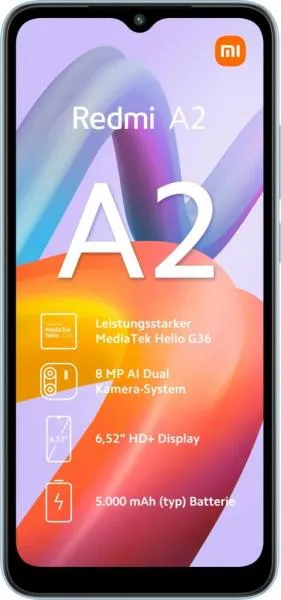

1. Specifications Comparison
| Feature | Xiaomi Redmi A2 | Xiaomi Poco F5 Pro | Practical Impact |
|---|---|---|---|
| Design | |||
| Dimensions (mm) | 164.9 x 76.8 x 9.1 | 162.8 x 75.4 x 8.6 | Poco F5 Pro is slightly smaller and thinner. |
| Weight (g) | 192 | 204 | Negligible weight difference in practical use. |
| Build | Unspecified | Unspecified | Build quality and material differences are unknown. |
| Display | |||
| Display Type | IPS LCD | AMOLED | AMOLED offers significantly better contrast, deeper blacks, and potentially brighter colors. |
| Display Size (inches) | 6.52 | 6.67 | Poco F5 Pro has a slightly larger screen. |
| Resolution | 720 x 1600 | 1440 x 3200 | Poco F5 Pro has a much sharper and more detailed display. |
| Refresh Rate | Unspecified | 120Hz | 120Hz on the Poco F5 Pro provides a smoother and more responsive user experience, especially for gaming and scrolling. |
| HDR | No | HDR10+, Dolby Vision | Poco F5 Pro supports HDR content for a wider dynamic range and richer colors in compatible videos. |
| Performance | |||
| Chipset | Mediatek Helio G36 (12 nm) | Qualcomm Snapdragon 8+ Gen 1 (4 nm) | Poco F5 Pro offers vastly superior processing power, enabling significantly faster performance in demanding tasks and gaming. |
| CPU | Octa-core (4x2.2 GHz Cortex-A53 & 4x1.7 GHz Cortex-A53) | Octa-core (1x3.0 GHz Cortex-X2 & 3x2.5 GHz Cortex-A710 & 4x1.80 GHz Cortex-A510) | The Poco F5 Pro's CPU architecture is significantly more powerful and efficient. |
| GPU | PowerVR GE8320 | Adreno 730 | Poco F5 Pro boasts a much more powerful GPU for high-end gaming and graphics processing. |
| RAM | 2/3/4GB | 8/12GB | Significantly more RAM in the Poco F5 Pro allows for smoother multitasking and handling of demanding applications. |
| Camera | |||
| Rear Camera | 8MP Main, 0.3MP Auxiliary | 64MP Main, 8MP Wide, 2MP Macro | Poco F5 Pro offers a higher resolution main sensor, a wide-angle lens for broader shots, and a dedicated macro lens. Image quality will likely be substantially better. |
| Front Camera | 5MP | 16MP | Poco F5 Pro has a higher resolution front camera for better selfies. |
| Video Recording | 1080p@30fps | Up to 8K@24fps | Poco F5 Pro supports much higher video resolution and frame rates. |
| Battery | |||
| Capacity | 5000 mAh | 5160 mAh | Similar battery capacities. |
| Fast Charging | 10W | 67W | Poco F5 Pro charges significantly faster. |
| Wireless Charging | No | 30W | Poco F5 Pro supports fast wireless charging. |
2. Key Differences Analysis
Xiaomi Redmi A2 Advantages:
- Lower Price: Significantly more affordable.
Xiaomi Poco F5 Pro Advantages:
- Significantly Faster Performance: The Snapdragon 8+ Gen 1 and ample RAM offer a vastly superior user experience for demanding tasks and gaming.
- Superior Display: AMOLED technology, higher resolution, faster refresh rate, and HDR support deliver a much better visual experience.
- More Versatile Camera System: Higher resolution sensors, wide-angle and macro lenses, and superior video recording capabilities.
- Faster Charging: Significantly faster wired and wireless charging.
- NFC: Enables contactless payments and other NFC functionalities.
Trade-offs:
- Price: The Poco F5 Pro is considerably more expensive.
3. User Profiles & Recommendations
Xiaomi Redmi A2:
- Budget-conscious users: Individuals seeking a basic smartphone for calling, texting, and light internet browsing.
- Secondary phone users: Suitable as a backup device or for specific tasks.
Xiaomi Poco F5 Pro:
- Power users: Individuals who demand top-tier performance for gaming, multitasking, and demanding applications.
- Photography enthusiasts: Users who prioritize camera quality and versatility.
- Tech-savvy users: Those who appreciate the latest display technology and fast charging speeds.
4. Decision Framework
Key Questions for Buyers:
- What is your budget? The Redmi A2 is a budget option, while the Poco F5 Pro is a premium device.
- What are your primary use cases? Basic tasks vs. demanding applications, gaming, and photography.
- How important are display quality and performance? The Poco F5 Pro offers a significant upgrade in both areas.
My Choice: Xiaomi Poco F5 Pro
While the Redmi A2 serves its purpose as an extremely budget-friendly device, the Poco F5 Pro is the clear winner for me. Its superior performance, stunning display, versatile camera system, and fast charging capabilities make it a compelling overall package. The price difference is significant, but the vastly improved user experience justifies the premium for anyone who values performance, visuals, and modern features. The Redmi A2 only makes sense if the budget is extremely tight and smartphone needs are very basic.
