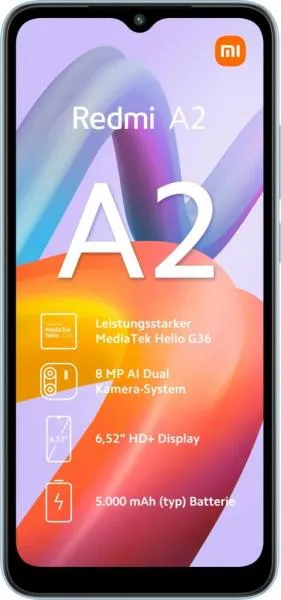

1. Specifications Comparison
| Feature | Xiaomi Redmi A2 | vivo V30 | Practical Impact |
|---|---|---|---|
| Design | |||
| Dimensions (mm) | 164.9 x 76.8 x 9.1 | 164.4 x 75.1 x 7.5 | Vivo V30 is slightly thinner and lighter, offering a more premium feel. |
| Weight (g) | 192 | 186 | Negligible difference in weight for daily use. |
| Build | Not specified | Not specified | Build quality and materials cannot be compared due to missing information. |
| Display | |||
| Display Type | IPS LCD | AMOLED | Vivo V30's AMOLED offers significantly better contrast, deeper blacks, and potentially brighter colors. |
| Display Size (inches) | 6.52 | 6.78 | Vivo V30 provides a larger screen for more immersive content consumption. |
| Resolution | 720 x 1600 | 1260 x 2800 | Vivo V30 has a much sharper display with significantly higher pixel density (453 ppi vs 269 ppi), resulting in crisper text and images. |
| Refresh Rate | Not specified | 120Hz | Vivo V30's 120Hz offers smoother scrolling and animations, leading to a more fluid user experience. |
| HDR | No | HDR10+ | Vivo V30 supports HDR10+ for enhanced dynamic range in compatible content. |
| Performance | |||
| Chipset | Mediatek Helio G36 (12 nm) | Qualcomm Snapdragon 7 Gen 3 (4 nm) | Vivo V30 boasts a significantly more powerful and efficient processor, enabling smoother multitasking, faster app loading, and better gaming performance. |
| CPU | Octa-core (4x2.2 GHz Cortex-A53 & 4x1.7 GHz Cortex-A53) | Octa-core (1x2.63 GHz Cortex-A715 & 3x2.4 GHz Cortex-A715 & 4x1.8 GHz Cortex-A510) | Vivo V30 has a more modern and powerful CPU architecture. |
| RAM | 2/3GB | 8GB | Vivo V30 offers substantially more RAM, allowing for seamless multitasking and keeping more apps open in the background. |
| Camera | |||
| Rear Camera | 8MP Main, 0.3MP unspecified | 50MP Main (OV50E), 50MP Wide Angle (S5KJN1) | Vivo V30 features a significantly more advanced camera system with higher resolution sensors, a wide-angle lens, and likely better image quality. Sensor details suggest superior low-light performance on the V30. |
| Front Camera | 5MP | 50MP | Vivo V30 offers a much higher resolution front camera for significantly better selfies. |
| Video Recording | 1080p@30fps | 4K@30fps | Vivo V30 supports 4K video recording for higher resolution videos. |
| Battery | |||
| Capacity | 5000 mAh | 5000 mAh | Both phones have the same battery capacity. |
| Fast Charging | 10W | 80W | Vivo V30 supports significantly faster charging, drastically reducing charging time. |
2. Key Differences Analysis
Xiaomi Redmi A2 Advantages:
- Lower Price: Significantly more affordable.
Vivo V30 Advantages:
- Superior Performance: Much faster processor, more RAM, and smoother user experience.
- Better Display: Higher resolution, AMOLED technology, HDR10+, and 120Hz refresh rate for a dramatically improved visual experience.
- Advanced Camera: Higher resolution sensors, wide-angle lens, 4K video recording, and potentially better image quality.
- Faster Charging: 80W fast charging significantly reduces charging time.
- More Features: NFC for contactless payments and more advanced connectivity options.
3. User Profiles & Recommendations
Xiaomi Redmi A2: Budget-conscious users who prioritize basic functionality for calls, texting, and light web browsing. Ideal for users with limited smartphone needs or as a secondary device.
Vivo V30: Users who value performance, a high-quality display, a good camera, and fast charging. Suitable for demanding tasks like gaming, content creation, and multitasking.
4. Decision Framework
Key Questions:
- What is your budget? The Redmi A2 is significantly cheaper.
- What are your primary smartphone usage patterns? For basic tasks, the Redmi A2 might suffice. For demanding tasks and multimedia consumption, the Vivo V30 is far superior.
- Which features are most important to you? Prioritize features like display quality, performance, camera capabilities, and charging speed.
My Choice: vivo V30
While the Redmi A2 offers an extremely budget-friendly option, the vivo V30 is the clear winner for me. The significantly improved display, powerful performance, advanced camera system, fast charging, and additional features like NFC justify the higher price. The difference in user experience would be substantial. The Snapdragon 7 Gen 3, coupled with 8GB of RAM and a 120Hz AMOLED display, promises a fluid and responsive experience that the Redmi A2 simply cannot match. Even though the price difference is significant, the V30 provides a substantial leap in quality and capabilities making it a worthwhile investment for a long-lasting and enjoyable smartphone experience. The Redmi A2 is a good option for an extremely tight budget and basic needs, but for a slightly higher investment, the V30 enters a completely different league.
