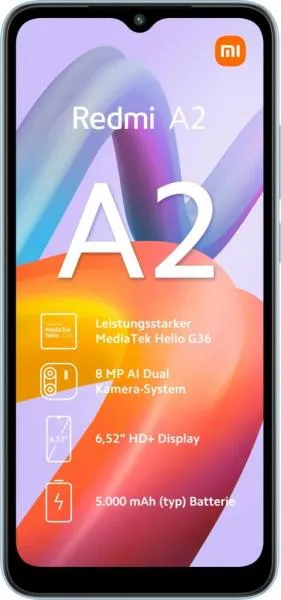
1. Specifications Comparison
| Feature | Xiaomi Redmi A2 | realme 8 | Practical Impact |
|---|---|---|---|
| Design | |||
| Dimensions (mm) | 164.9 x 76.8 x 9.1 | 162 x 75.1 x 8.7 | Realme 8 is slightly smaller and thinner. |
| Weight (g) | 192 | 191 | Negligible weight difference. |
| Build Materials | Not specified | Not specified | Cannot compare build quality and durability. |
| Display | |||
| Display Type | IPS LCD | LTPO AMOLED | Realme 8 offers significantly better contrast, color accuracy, and power efficiency due to AMOLED technology. LTPO allows for dynamic refresh rate adjustment, saving battery. |
| Display Size (inches) | 6.52 | 6.78 | Realme 8 has a larger display, providing a more immersive experience for media consumption. |
| Resolution | 720 x 1600 | 2780 x 1264 | Realme 8 has a much sharper and more detailed display (450 ppi vs 269 ppi). |
| Refresh Rate | Not specified | 120Hz | Realme 8's 120Hz refresh rate delivers smoother animations and scrolling. |
| Peak Brightness | 400 nits (typ) | 1600 nits (HBM) | Realme 8 is significantly brighter, ensuring better visibility in sunlight. |
| Performance | |||
| Chipset | Mediatek Helio G36 (12 nm) | Qualcomm SM7675 Snapdragon 7+ Gen 3 (4 nm) | Realme 8's processor is significantly more powerful, enabling smoother multitasking, faster app loading, and better gaming performance. The 4nm process also indicates better power efficiency. |
| CPU | Octa-core (4x2.2 GHz Cortex-A53 & 4x1.7 GHz Cortex-A53) | Octa-core (1x2.8 GHz Cortex-X4 & 4x2.6 GHz Cortex-A720 & 3x1.9 GHz Cortex-A520) | Realme 8 boasts a more modern and powerful CPU architecture. |
| GPU | PowerVR GE8320 | Adreno 732 | Realme 8 has a much more capable GPU, suitable for demanding games and graphics-intensive tasks. |
| RAM | 2GB/3GB | 12GB | Realme 8 offers vastly more RAM, enabling seamless multitasking and preventing app closures in the background. |
| Camera | |||
| Rear Camera | 8MP Main, 0.3MP unspecified | Not specified | Cannot compare rear camera capabilities due to missing Realme 8 specifications. |
| Front Camera | 5MP | Not specified | Cannot compare front camera capabilities due to missing Realme 8 specifications. |
| Battery | |||
| Capacity | 5000 mAh | 5500 mAh | Realme 8 has a slightly larger battery capacity. |
| Charging | 10W Fast Charging | Not specified | Cannot compare charging speeds due to missing Realme 8 specifications. |
| Other | |||
| OS | Android 12 | Android 14 | Realme 8 ships with a newer Android version, offering potential feature and security advantages. |
| NFC | No | Yes | Realme 8 supports NFC for contactless payments and other functionalities. |
2. Key Differences Analysis
Realme 8 Advantages:
- Significantly superior performance: The Snapdragon 7+ Gen 3 chip, coupled with 12GB RAM, offers a vastly smoother and more responsive user experience.
- Much better display: The LTPO AMOLED display with 120Hz refresh rate delivers vibrant colors, deep blacks, and smooth scrolling.
- Newer Android version: Android 14 potentially offers more features and improved security.
- NFC support: Enables contactless payments and other NFC functionalities.
Xiaomi Redmi A2 Advantages:
- Lower price: Positioned in the "low price" range, it's significantly more affordable.
3. User Profiles & Recommendations
Xiaomi Redmi A2: Budget-conscious users who prioritize basic communication and light tasks like browsing and social media. Suitable for users who don't play demanding games or require high performance.
Realme 8: Users who value performance, a premium display, and the latest features. Ideal for mobile gamers, power users, and those who consume a lot of media on their phones.
4. Decision Framework
Key Questions for Buyers:
- What is your budget? The Redmi A2 is significantly cheaper.
- What are your primary use cases? For basic tasks, the Redmi A2 suffices. For demanding tasks and gaming, the Realme 8 is vastly superior.
- How important is display quality and performance? The Realme 8 provides a substantial upgrade in these areas.
My Choice: realme 8
While lacking some camera details, the realme 8 is the clear winner for me. The significantly superior processor, display, RAM, and newer Android version offer a vastly better user experience. Even without knowing the camera specifics or charging speed, the performance and display advantages alone justify the higher price for most users beyond those strictly on the tightest budget needing only the most basic functionality. The Redmi A2 might be acceptable for extremely budget-conscious users who only need basic functionality, but the Realme 8 offers a far more future-proof and enjoyable user experience.
