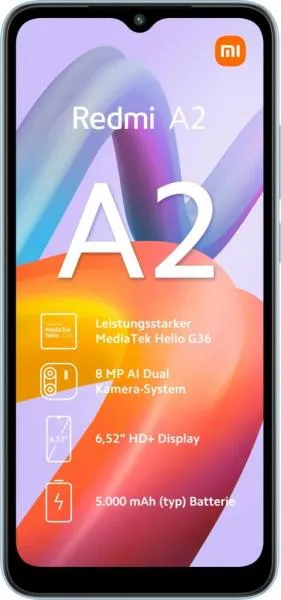

1. Specifications Comparison
| Feature | Xiaomi Redmi A2 | Honor 200 Pro | Practical Impact |
|---|---|---|---|
| Design | |||
| Dimensions (mm) | 164.9 x 76.8 x 9.1 | 163.3 x 75.2 x 8.2 | Honor 200 Pro is slightly smaller and thinner. |
| Weight (g) | 192 | 199 | Negligible weight difference. |
| Build Material | Not specified | Not specified | Cannot compare build quality. |
| Display | |||
| Display Type | IPS LCD | OLED | Honor 200 Pro offers significantly better contrast, deeper blacks, and potentially brighter colors. |
| Display Size (inches) | 6.52 | 6.78 | Honor 200 Pro has a larger display, providing more immersive content consumption. |
| Resolution | 720 x 1600 | 1224 x 2700 | Honor 200 Pro has a much sharper and more detailed display. |
| Refresh Rate | Not specified | 120Hz | Honor 200 Pro's 120Hz refresh rate results in smoother animations and scrolling. |
| Performance | |||
| Chipset | Mediatek Helio G36 (12 nm) | Qualcomm Snapdragon 8s Gen 3 (4 nm) | Honor 200 Pro offers vastly superior processing power and performance. |
| CPU | Octa-core (4x2.2 GHz Cortex-A53 & 4x1.7 GHz Cortex-A53) | Octa-core (1x3.0 GHz Cortex-X4 & 4x2.8 GHz Cortex-A720 & 3x2.0 GHz Cortex-A520) | Honor 200 Pro's CPU is significantly faster and more efficient. |
| RAM | 2/3/4GB | 12/16GB | Honor 200 Pro has much more RAM, allowing for seamless multitasking and smoother performance with demanding applications. |
| Storage | 32/64GB | 256GB/512GB/1TB | Honor 200 Pro offers significantly more storage. |
| Camera | |||
| Rear Camera | 8MP Main, 0.3MP unspecified | 50MP Main, 12MP Wide, 50MP Telephoto | Honor 200 Pro boasts a significantly more versatile and higher resolution camera system. |
| Front Camera | 5MP | 50MP | Honor 200 Pro provides higher resolution selfies. |
| Video Recording | 1080p@30fps | 4K@30fps with OIS, EIS | Honor 200 Pro offers higher resolution video recording with stabilization. |
| Battery | |||
| Capacity | 5000 mAh | 5200 mAh | Similar battery capacities, though real-world battery life depends on other factors like display and processor efficiency. |
| Fast Charging | 10W | 100W/66W Wireless | Honor 200 Pro charges significantly faster, and also supports fast wireless charging. |
2. Key Differences Analysis
Xiaomi Redmi A2 Advantages:
- Lower Price: Significantly more affordable.
Honor 200 Pro Advantages:
- Superior Performance: Significantly faster processor, more RAM, and smoother display.
- Better Display: Higher resolution, OLED technology, 120Hz refresh rate.
- More Versatile Camera: Higher resolution sensors, telephoto lens, optical image stabilization, and 4K video recording.
- Faster Charging: Significantly faster wired and wireless charging.
- More Storage: Offers much larger storage options.
- NFC: Supports contactless payments and data transfer.
- More Up-to-Date Software: Ships with a newer Android version and longer software support lifespan.
Trade-offs:
- The Redmi A2 sacrifices performance, features, and build quality for affordability.
- The Honor 200 Pro commands a much higher price for its premium features.
3. User Profiles & Recommendations
Xiaomi Redmi A2: Budget-conscious users who prioritize basic communication and light tasks like browsing and social media. Ideal for users who primarily need a simple, affordable phone for calling and texting.
Honor 200 Pro: Users who demand top-tier performance, a high-quality display, a versatile camera, and fast charging. Suitable for demanding tasks like gaming, content creation, and heavy multitasking.
4. Decision Framework
Key Questions for Buyers:
- What is your budget? The Redmi A2 is significantly cheaper.
- What are your primary phone usage patterns? Basic communication vs. demanding tasks.
- Which features are most important to you? Performance, display, camera, battery life.
Scenario-Based Recommendations:
- Limited Budget, Basic Needs: Redmi A2
- Balanced Needs and Budget: Consider other mid-range options.
- Demanding User, High Budget: Honor 200 Pro
My Choice: Honor 200 Pro
While the Redmi A2 offers great value for its price, the Honor 200 Pro is the clear winner for me. Its superior performance, stunning display, versatile camera system, and fast charging capabilities are compelling. The significantly improved user experience justifies the higher price, especially for a power user or someone who values a premium mobile experience. The longer software support lifespan of the Honor 200 Pro also ensures a more future-proof device. While budget is a crucial factor, the advancements offered by the Honor 200 Pro provide a more enjoyable and capable smartphone experience in the long run.
