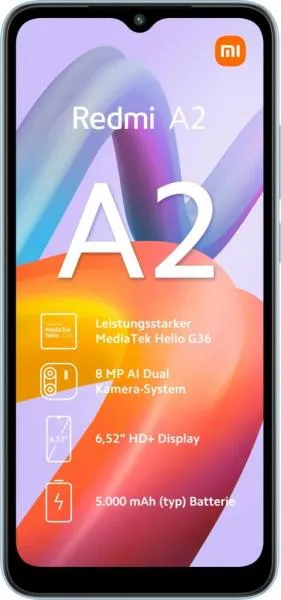

1. Specifications Comparison
| Feature | Xiaomi Redmi A2 | Google Pixel 8 Pro | Practical Impact |
|---|---|---|---|
| Design | |||
| Dimensions (mm) | 164.9 x 76.8 x 9.1 | 162.6 x 76.5 x 8.8 | Pixel 8 Pro is slightly smaller and thinner. Negligible difference in everyday use. |
| Weight (g) | 192 | 213 | Pixel 8 Pro is noticeably heavier, potentially impacting one-handed use. |
| Build Material | Not specified | Not specified | Cannot compare build quality and durability without material information. |
| Display | |||
| Display Type | IPS LCD | LTPO OLED | Pixel 8 Pro offers significantly better contrast, deeper blacks, and wider viewing angles due to OLED technology. |
| Display Size (inches) | 6.52 | 6.7 | Pixel 8 Pro has a slightly larger screen, providing more immersive content consumption. |
| Resolution (px) | 720 x 1600 | 1344 x 2992 | Pixel 8 Pro boasts much higher resolution, resulting in significantly sharper text and images. |
| Refresh Rate (Hz) | Not specified | 120 | Pixel 8 Pro's 120Hz refresh rate delivers smoother animations and scrolling compared to the Redmi A2's unspecified rate (likely 60Hz). |
| Peak Brightness (nits) | 400 (typ) | 2400 (peak) | Pixel 8 Pro is vastly brighter, ensuring excellent outdoor visibility. |
| Performance | |||
| Chipset | Mediatek Helio G36 (12 nm) | Google Tensor G3 (4 nm) | Tensor G3 is significantly more powerful, enabling faster app loading, multitasking, and demanding gaming. |
| CPU | Octa-core (4x2.2 GHz Cortex-A53 & 4x1.7 GHz Cortex-A53) | Nona-core (1x3.0 GHz Cortex-X3 & 4x2.45 GHz Cortex-A715 & 4x2.15 GHz Cortex-A510) | Tensor G3's more modern architecture and higher clock speeds provide a substantial performance advantage. |
| RAM (GB) | 2/3 | 12 | Pixel 8 Pro's 12GB RAM allows for seamless multitasking and keeps more apps in memory. Redmi A2's lower RAM may lead to more frequent app reloading. |
| Storage (GB) | 32/64 | 128/256/512/1000 | Pixel 8 Pro offers significantly more storage options for users with large media libraries. |
| Camera | |||
| Rear Camera (MP) | 8 + 0.3 (depth) | 50 + 48 (wide/macro) + 48 (telephoto) | Pixel 8 Pro features a vastly superior camera system with higher resolution sensors, advanced features like optical zoom and macro, and significantly better image quality. |
| Front Camera (MP) | 5 | 10.8 | Pixel 8 Pro offers higher resolution for selfies. |
| Video Recording | 1080p@30fps | Up to 4K@60fps with HDR, OIS, EIS | Pixel 8 Pro allows for much higher resolution and higher frame rate video recording with advanced stabilization. |
| Battery | |||
| Capacity (mAh) | 5000 | 5050 | Negligible difference in battery capacity. Real-world battery life depends heavily on usage and optimization. |
| Charging | 10W fast charging | 30W fast charging, 23W wireless charging | Pixel 8 Pro charges significantly faster and supports wireless charging. |
2. Key Differences Analysis
Xiaomi Redmi A2 Advantages:
- Lower Price: Significantly more affordable.
- Lighter Weight: Easier to hold for extended periods.
Google Pixel 8 Pro Advantages:
- Superior Performance: Significantly faster processor, more RAM, smoother user experience.
- High-Quality Display: Brighter, sharper, and more vibrant OLED display with a 120Hz refresh rate.
- Advanced Camera System: Versatile camera setup with higher resolution sensors, optical zoom, and advanced features.
- Faster Charging & Wireless Charging: More convenient charging options.
- Premium Features: NFC, latest Android version with longer support, more storage options.
Trade-offs:
- Redmi A2: Sacrifices performance, display quality, camera capabilities, and features for affordability.
- Pixel 8 Pro: Significantly more expensive.
3. User Profiles & Recommendations
Xiaomi Redmi A2:
- Ideal User: Budget-conscious users who prioritize basic communication and light usage (calls, texting, browsing). Students or elderly users with limited needs.
- Use Cases: Basic communication, simple web browsing, casual social media use.
Google Pixel 8 Pro:
- Ideal User: Power users, photographers, videographers, gamers, and anyone who demands top-tier performance, display quality, and camera capabilities.
- Use Cases: Demanding gaming, professional photography and videography, content creation, multitasking, heavy app usage.
4. Decision Framework
Key Questions for Buyers:
- What is your budget? The Redmi A2 is significantly cheaper.
- What are your primary smartphone needs? Basic communication vs. demanding tasks and multimedia consumption.
- How important are features like camera quality, display quality, and performance? The Pixel 8 Pro excels in these areas.
Scenario-Based Recommendations:
- Limited Budget, Basic Needs: Redmi A2
- Best Possible Camera and Performance: Pixel 8 Pro
- Balance of Performance and Value: Consider other mid-range options (not listed here).
My Choice: Google Pixel 8 Pro
While significantly more expensive, the Google Pixel 8 Pro offers a vastly superior user experience in almost every aspect. The performance difference between the Tensor G3 and the Helio G36 is substantial, impacting daily tasks, app loading times, and gaming capabilities. The OLED display with a 120Hz refresh rate provides a significantly better visual experience. The camera system on the Pixel 8 Pro is in a different league, offering versatility and image quality that the Redmi A2 cannot match. While the Redmi A2 offers excellent value for its price, my personal priorities lie with performance, display quality, and a capable camera, making the Pixel 8 Pro the clear winner for me. The longevity provided by guaranteed Android updates further solidifies this choice.
