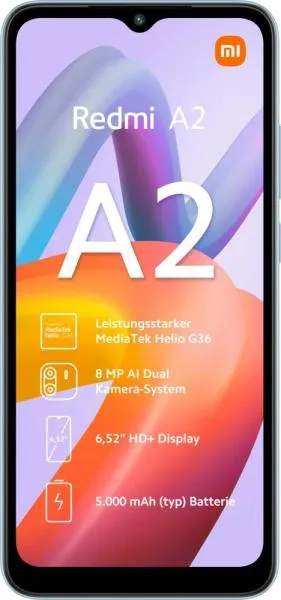

1. Specifications Comparison
| Feature | Xiaomi Redmi A2+ | ZTE Blade A75 4G | Practical Impact |
|---|---|---|---|
| Design | |||
| Dimensions (mm) | 164.9 x 76.8 x 9.1 | 164.1 x 75.8 x 8.6 | Virtually identical in size and feel |
| Weight (g) | 192 | 189 | Negligible weight difference |
| Build Materials | Not specified | Not specified | Cannot compare build quality |
| Display | |||
| Size (inches) | 6.52 | 6.6 | A75 slightly larger, minimal difference in real-world usage |
| Resolution (px) | 720 x 1600 | 720 x 1612 | Nearly identical resolutions, similar sharpness |
| Display Type | IPS LCD | IPS LCD | Same display technology, expect similar color accuracy and viewing angles |
| Refresh Rate (Hz) | Not specified | 90 | A75's 90Hz offers smoother scrolling and animations |
| Performance | |||
| Chipset | Mediatek Helio G36 (12 nm) | Unisoc T606 (12 nm) | Both entry-level chipsets, T606 likely slightly more powerful |
| CPU | Octa-core (4x2.2 GHz Cortex-A53 & 4x1.7 GHz Cortex-A53) | Octa-core (2x1.6 GHz Cortex-A75 & 6x1.6 GHz Cortex-A55) | A75's Cortex-A75 cores offer better performance in demanding tasks |
| GPU | PowerVR GE8320 | Mali-G57 MP1 | Difficult to compare without benchmarks, expect similar gaming performance |
| RAM | 2GB/3GB | 4GB/8GB | A75 offers significantly more RAM, leading to better multitasking and app performance |
| Storage | 32GB/64GB | 256GB | A75 offers vastly more storage |
| Camera | |||
| Rear Camera | 8MP + 0.3MP | 50MP + 0.3MP | A75's 50MP main sensor likely captures more detail |
| Front Camera | 5MP | 8MP | A75 likely produces better selfies |
| Video Recording | 1080p@30fps | 1080p@30fps | Identical video recording capabilities |
| Battery | |||
| Capacity (mAh) | 5000 | 5000 | Same battery capacity, expect similar battery life |
| Charging | 10W | 22.5W | A75 charges significantly faster |
| Other | |||
| NFC | No | Yes | A75 supports contactless payments and data transfer |
| USB | microUSB 2.0 | USB Type-C 2.0 | A75 uses the more modern and versatile USB-C port |
| OS | Android 12 | Android 13 | A75 runs a newer Android version with potential feature and security updates |
2. Key Differences Analysis
ZTE Blade A75 4G Advantages:
- Higher Refresh Rate Display: Smoother user experience.
- More Powerful CPU & More RAM: Better performance for demanding tasks and multitasking.
- Significantly More Storage: Less concern about running out of space.
- Higher Resolution Main Camera: Potentially better image quality.
- Faster Charging: Less downtime.
- NFC: Enables contactless payments.
- USB-C: More modern and versatile port.
- Newer Android Version: Likely longer software support.
Xiaomi Redmi A2+ Advantages:
- Potentially Lower Price: Could be a more budget-friendly option. (Specific pricing not available for comparison).
3. User Profiles & Recommendations
ZTE Blade A75 4G: Suitable for users who prioritize performance, a smooth display, ample storage, a modern USB port, and NFC functionality. Ideal for light gaming, social media, web browsing, and general smartphone use.
Xiaomi Redmi A2+: Best suited for budget-conscious users who primarily need a basic smartphone for calling, texting, and very light app usage. Significant compromises must be made in performance and features.
4. Decision Framework
Key Questions for Buyers:
- What is your budget? The Redmi A2+ is likely cheaper, but the A75 offers significantly better value if within budget.
- What are your primary smartphone uses? The A75 is better equipped for modern usage, while the A2+ is for basic needs.
- How important are features like NFC, faster charging, and a smoother display? These are key differentiators favoring the A75.
My Choice: ZTE Blade A75 4G
While potentially more expensive, the ZTE Blade A75 4G offers significant advantages in performance, features, and future-proofing. The larger RAM, vastly greater storage, faster charging, NFC, USB-C, and newer Android version make it a far superior device for most users. The Redmi A2+ is only a viable option for extremely budget-constrained users willing to accept significant performance limitations and outdated technology. The A75's benefits heavily outweigh its potential price premium in the long run.
