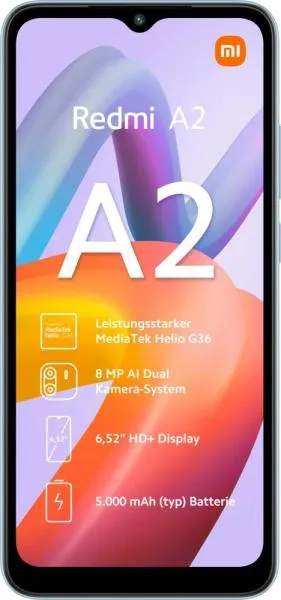

1. Specifications Comparison
| Feature | Xiaomi Redmi A2+ | Xiaomi Poco C65 | Practical Impact |
|---|---|---|---|
| Design | |||
| Dimensions (mm) | 164.9 x 76.8 x 9.1 | 168 x 78 x 8.1 | Poco C65 slightly larger |
| Weight (g) | 192 | 192 | Same weight |
| Build | Not specified | Not specified | Build quality comparison impossible without details |
| Fingerprint Sensor | Rear-mounted | Side-mounted | Preference-dependent; side often more ergonomic |
| Display | |||
| Size (inches) | 6.52 | 6.74 | Poco C65 offers a larger viewing area |
| Resolution (px) | 720 x 1600 | 720 x 1600 | Same resolution, but Poco C65 has slightly lower PPI due to larger size |
| Panel Type | IPS LCD | IPS LCD | Similar visual experience expected, though Poco C65 specs indicate higher typical brightness (450 vs 400 nits) and high brightness mode (600 nits) |
| Refresh Rate (Hz) | Not specified | 90 | Poco C65's 90Hz will provide smoother scrolling and animations |
| Performance | |||
| Chipset | Mediatek Helio G36 (12 nm) | Mediatek Helio G85 (12 nm) | Poco C65 has a more powerful CPU and GPU, leading to better performance in demanding tasks and games |
| CPU | Octa-core (4x2.2 GHz Cortex-A53 & 4x1.7 GHz Cortex-A53) | Octa-core (2x2.0 GHz Cortex-A75 & 6x1.8 GHz Cortex-A55) | Poco C65's CPU architecture is more modern and efficient |
| GPU | PowerVR GE8320 | Mali-G52 MC2 | Poco C65's GPU offers significantly better graphics performance |
| RAM (GB) | 2/3 | 6/8 | Poco C65 offers more RAM, enabling better multitasking and smoother performance |
| OS | Android 12 | Android 13 | Poco C65 comes with a newer OS version, potentially offering more features and better optimization |
| Camera | |||
| Rear Camera (MP) | 8 MP + 0.3MP | 50MP + 2MP + 2MP | Poco C65 boasts a much higher resolution main sensor, promising significantly better image quality. It also has dedicated Macro and depth sensors. |
| Front Camera (MP) | 5 MP | 8 MP | Poco C65 has a higher resolution selfie camera |
| Video Recording | 1080p@30fps | 1080p@30fps | Equivalent video resolution. Poco C65 specs indicate 120fps slow-motion capability, not mentioned for Redmi A2+ |
| Battery | |||
| Capacity (mAh) | 5000 | 5000 | Same battery capacity |
| Charging | 10W Fast Charging | 18W Fast Charging | Poco C65 charges faster |
| USB | microUSB 2.0 | USB Type-C 2.0 | Poco C65 uses the more modern and versatile USB-C port |
| Other | |||
| NFC | No | Yes | Poco C65 supports contactless payments and data transfer |
2. Key Differences Analysis
Xiaomi Redmi A2+ Advantages:
- Potentially lower price (based on "low price" range and lower specs).
Xiaomi Poco C65 Advantages:
- Significantly better performance: The Helio G85 chipset, more RAM, and better GPU translate to a smoother user experience, especially for gaming and multitasking.
- Improved camera: The 50MP main camera and dedicated macro/depth sensors will capture superior photos.
- Larger and smoother display: The 6.74-inch screen with a 90Hz refresh rate provides a more immersive and responsive visual experience.
- Faster charging: 18W charging significantly reduces downtime compared to 10W.
- Modern connectivity: USB-C port and NFC enable faster data transfer, easier charging, and contactless payments.
- Newer OS: Android 13 offers potential performance and feature advantages.
3. User Profiles & Recommendations
Xiaomi Redmi A2+: Suitable for budget-conscious users who prioritize basic communication (calls, texts, social media) and light web browsing. Ideal for users with minimal performance needs.
Xiaomi Poco C65: Ideal for users who value performance, gaming, photography, and a smoother user experience. The larger display and faster charging are also beneficial for media consumption.
4. Decision Framework
Key Questions for Buyers:
- What is your budget? The Redmi A2+ is likely cheaper.
- What are your primary use cases? Basic communication vs. gaming, photography, media consumption.
- Do you prioritize performance and modern features? The Poco C65 excels in these areas.
Scenario-Based Recommendations:
- Limited budget, basic usage: Redmi A2+
- Balanced budget, desire for good performance and camera: Poco C65
My Choice: Xiaomi Poco C65
While pricing information is incomplete, the Poco C65 offers substantial upgrades in performance, camera, display, and connectivity for a likely small price difference. The Helio G85, coupled with more RAM and a 90Hz display, delivers a noticeably better user experience. The 50MP camera and USB-C port are significant advantages. Unless budget is extremely tight, the Poco C65 offers far better value. Even if the Poco C65 is considerably more expensive, the performance and feature difference would make it worthwhile for most users beyond those seeking the absolute cheapest option.
