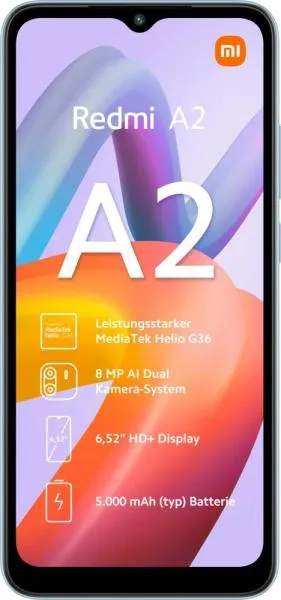
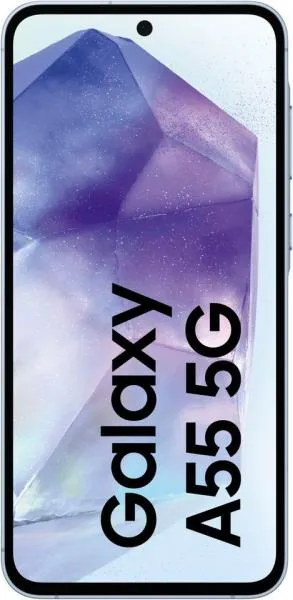
1. Specifications Comparison
| Feature | Xiaomi Redmi A2+ | Samsung Galaxy A55 | Practical Impact |
|---|---|---|---|
| Design | |||
| Dimensions (mm) | 164.9 x 76.8 x 9.1 | 161.1 x 77.4 x 8.2 | A55 slightly shorter, wider, and significantly thinner. |
| Weight (g) | 192 | 213 | A2+ noticeably lighter, potentially more comfortable for extended use. |
| Build | Unspecified | Unspecified | Build materials and durability are unknown for both, limiting comparison. |
| Display | |||
| Display Type | IPS LCD | Super AMOLED | A55 offers significantly better contrast, colors, and viewing angles. |
| Size (inches) | 6.52 | 6.6 | Negligible size difference. |
| Resolution | 720 x 1600 | 1080 x 2340 | A55 boasts much sharper visuals due to higher resolution (390 vs 269 ppi). Impacts clarity of text, images, and videos. |
| Refresh Rate | Unspecified | 120Hz | A55's 120Hz refresh rate provides smoother animations and scrolling compared to the A2+'s unspecified rate (likely 60Hz). |
| HDR | No | HDR10+ | A55 supports HDR content for a wider dynamic range and more vibrant visuals in compatible content. |
| Performance | |||
| Chipset | Mediatek Helio G36 (12 nm) | Exynos 1480 (4 nm) | A55's 4nm chipset significantly outperforms the A2+'s 12nm chip in speed and efficiency, leading to smoother multitasking, faster app loading, and better gaming performance. |
| CPU | Octa-core (4x2.2 GHz Cortex-A53 & 4x1.7 GHz Cortex-A53) | Octa-core (4x2.75 GHz Cortex-A78 & 4x2.0 GHz Cortex-A55) | A55 has a more powerful and modern CPU architecture resulting in significantly improved performance. |
| GPU | PowerVR GE8320 | Xclipse 530 | A55 offers significantly better graphics performance for demanding games and applications. |
| RAM | 2GB/3GB | 8GB/12GB | A55's vastly larger RAM allows for significantly better multitasking and prevents apps from closing in the background. |
| Camera | |||
| Rear Camera | 8MP Main, 0.3MP unspecified | 50MP Main, 13MP Wide, 5MP Macro | A55 provides more versatile camera setup with higher resolution main sensor, resulting in superior image quality and detail. Macro lens adds close-up shooting capabilities. |
| Front Camera | 5MP | 32MP | A55's higher resolution front camera offers drastically improved selfie quality. |
| Video Recording | 1080p@30fps | 4K@30fps | A55 capable of recording much higher resolution videos. |
| Battery | |||
| Capacity | 5000 mAh | 5000 mAh | Similar battery capacities. |
| Fast Charging | 10W | 25W | A55 charges significantly faster. |
2. Key Differences Analysis
Xiaomi Redmi A2+ Advantages:
- Lighter: More comfortable for extended use.
- Lower Price: Significantly more affordable.
Samsung Galaxy A55 Advantages:
- Superior Display: AMOLED with higher resolution, refresh rate, and HDR support for a dramatically better viewing experience.
- Significantly Faster Performance: More powerful chipset, CPU, GPU, and much larger RAM provide a fluid user experience.
- More Versatile and Higher Quality Cameras: Higher resolution sensors, wide-angle and macro lenses, and 4K video recording capabilities.
- Faster Charging: Reduces downtime.
- More Modern Features: NFC for mobile payments and other functionalities.
Trade-offs:
- Price: The A55 is considerably more expensive. The A2+ prioritizes affordability over performance and features.
3. User Profiles & Recommendations
Xiaomi Redmi A2+: Budget-conscious users who prioritize basic communication (calls, texts, web browsing) and light app usage. Ideal for users who need a secondary phone or a simple device for less demanding tasks.
Samsung Galaxy A55: Users who value a smooth and responsive user experience, a high-quality display, excellent camera capabilities, and modern features like NFC. Suitable for gaming, media consumption, photography, and multitasking.
4. Decision Framework
Key Questions for Buyers:
- What is your budget? The A2+ is a budget phone, while the A55 is a mid-range device.
- What are your primary use cases? Basic communication vs. demanding tasks like gaming and photography.
- Which features are most important to you? Display quality, performance, camera, battery life, etc.
My Choice: Samsung Galaxy A55
While the Xiaomi Redmi A2+ offers an incredibly low price point, the Samsung Galaxy A55 provides a significantly superior user experience in almost every aspect. The vastly improved display, performance, cameras, and the inclusion of NFC justify the higher price for most users. The A2+ severely compromises on performance and features, making it suitable only for extremely budget-constrained individuals with very basic needs. The A55 represents a much better long-term investment due to its superior hardware and future-proofing with software updates. While acknowledging the importance of budget considerations, the difference in user experience is significant enough to make the A55 the clear winner for me.
