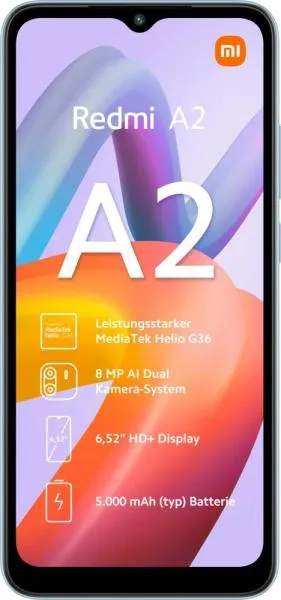

1. Specifications Comparison
| Feature | Xiaomi Redmi A2+ | Samsung Galaxy A14 | Practical Impact |
|---|---|---|---|
| Design | |||
| Dimensions (mm) | 164.9 x 76.8 x 9.1 | 167.7 x 78 x 9.1 | A14 slightly larger; negligible difference in daily use |
| Weight (g) | 192 | 201 | A2+ slightly lighter; negligible difference |
| Build Material | Unspecified | Unspecified | Cannot compare build quality |
| Display | |||
| Display Type | IPS LCD | PLS LCD | Similar visual quality, PLS LCD might offer slightly better color accuracy |
| Size (inches) | 6.52 | 6.6 | A14 slightly larger screen |
| Resolution | 720 x 1600 | 1080 x 2408 | A14 significantly sharper; noticeable difference in clarity for text and images |
| Pixel Density (PPI) | 269 | 400 | A14 much sharper; noticeable impact on image quality and text clarity |
| Refresh Rate | Unspecified | Unspecified | Cannot compare smoothness of scrolling and animations |
| Performance | |||
| Chipset | Mediatek Helio G36 (12 nm) | Mediatek Helio G80 (12 nm) / Exynos 1330 | A14 likely more powerful, especially the Exynos version; Impacts gaming and multitasking performance |
| CPU | Octa-core (4x2.2 GHz Cortex-A53 & 4x1.7 GHz Cortex-A53) | Octa-core (2x2.0 GHz Cortex-A75 & 6x1.8 GHz Cortex-A55) / Unspecified for Exynos | A14's CPU architecture is more modern and efficient, resulting in better performance. |
| GPU | PowerVR GE8320 | Mali-G52 MC2 / Mali-G68 MC4 | A14's GPU should offer better graphics performance for gaming |
| RAM | 2/3 GB | 4/6 GB | A14 offers more RAM; Improved multitasking and app switching |
| Storage | 32/64 GB | 128 GB | A14 offers significantly more storage; Allows for more apps, photos, and videos |
| Camera | |||
| Rear Camera | 8 MP + 0.3 MP | 50 MP + 2 MP + 2 MP | A14 boasts a significantly higher resolution main camera; Expect better image quality from A14 |
| Front Camera | 5 MP | 13 MP | A14 has a higher resolution front camera; Better selfie quality |
| Video Recording | 1080p@30fps | 1080p@30fps | Similar video recording capabilities in terms of resolution and frame rate; A14 may offer better video stabilization and features due to a more powerful processor. |
| Battery | |||
| Capacity (mAh) | 5000 | 5000 | Similar battery capacity; Expected similar battery life, but real-world usage may vary |
| Fast Charging | 10W | 15W | A14 charges faster |
| NFC | No | Yes | A14 allows for contactless payments and data transfer |
2. Key Differences Analysis
Xiaomi Redmi A2+ Advantages:
- Potentially Lower Price: Likely cheaper given the "low price" designation.
Samsung Galaxy A14 Advantages:
- Significantly Better Display: Higher resolution and pixel density result in a sharper and more enjoyable viewing experience.
- Superior Performance: More powerful processor and more RAM for smoother multitasking and gaming.
- Enhanced Camera System: Higher resolution sensors and potentially better image processing capabilities.
- Faster Charging: 15W vs 10W, resulting in quicker charging times.
- NFC Enabled: Supports contactless payments and other NFC functionalities.
- More Storage: Offers more space for apps, photos, and videos.
- More recent Android Version: Ships with Android 13, offering potential performance and security advantages over Android 12.
3. User Profiles & Recommendations
Xiaomi Redmi A2+: Budget-conscious users who prioritize basic functionality (calls, texts, browsing) and long battery life over performance and advanced features. Suitable for light users or as a secondary phone.
Samsung Galaxy A14: Users who value a good display, smooth performance, decent camera quality, and modern features like NFC. Suitable for moderate to heavy users, including gamers and those who consume media on their phones.
4. Decision Framework
Key Questions for Buyers:
- What is your budget? The A2+ is likely much cheaper.
- What are your primary use cases? Basic communication vs. gaming, photography, multitasking.
- How important are display quality and performance? The A14 excels in these areas.
Scenario-Based Recommendations:
- Tight budget, basic usage: Redmi A2+
- Balanced needs and budget: Galaxy A14
- Prioritize performance and features: Galaxy A14
My Choice: Samsung Galaxy A14
While the Redmi A2+ might be appealing for its lower price, the Galaxy A14 offers a significantly better overall user experience due to its superior display, performance, camera, and the inclusion of NFC. The difference in price is likely justified by these substantial improvements. Even if the Exynos 1330 version benchmarks lower than the Helio G80, the overall package of the A14, including OS updates and potential camera processing, makes it a more future-proof and enjoyable device to use. For a moderate price increase, the A14 provides a significant leap in usability and longevity.
