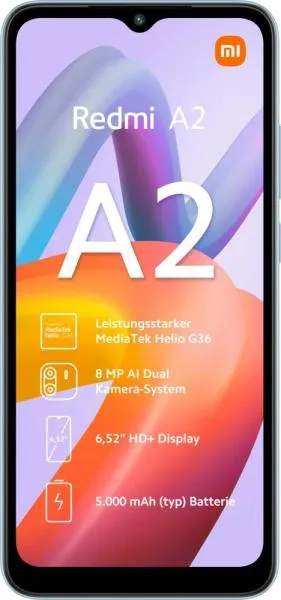

1. Specifications Comparison
| Feature | Xiaomi Redmi A2+ | Google Pixel 8 | Practical Impact |
|---|---|---|---|
| Design | |||
| Dimensions (mm) | 164.9 x 76.8 x 9.1 | 150.5 x 70.8 x 8.9 | Pixel 8 is noticeably smaller and more pocketable. |
| Weight (g) | 192 | 187 | Negligible weight difference in practical use. |
| Build | Unspecified | Unspecified | Material differences could impact durability and premium feel, but information is lacking. |
| Display | |||
| Display Type | IPS LCD | OLED | Pixel 8's OLED offers significantly better contrast, deeper blacks, and wider viewing angles. |
| Display Size (inches) | 6.52 | 6.2 | Redmi A2+ offers a larger screen for media consumption, but Pixel 8 is more one-hand friendly. |
| Resolution | 720 x 1600 | 1080 x 2400 | Pixel 8 boasts much sharper visuals due to higher resolution and pixel density. |
| Refresh Rate | Unspecified | 120Hz | Pixel 8's 120Hz refresh rate will provide a noticeably smoother user experience in scrolling and animations. |
| Peak Brightness | 400 nits (typ) | 2000 nits (peak) | Pixel 8 will be far more readable in direct sunlight. |
| Performance | |||
| Chipset | Mediatek Helio G36 (12 nm) | Google Tensor G3 (4 nm) | Tensor G3 offers vastly superior performance and efficiency due to its advanced architecture and smaller process node. |
| CPU | Octa-core (4x2.2 GHz Cortex-A53 & 4x1.7 GHz Cortex-A53) | Nona-core (1x3.0 GHz Cortex-X3 & 4x2.45 GHz Cortex-A715 & 4x2.15 GHz Cortex-A510) | Pixel 8 will handle demanding tasks and multitasking with significantly greater ease. |
| RAM | 2GB/3GB | 8GB | Pixel 8's larger RAM enables smoother multitasking and prevents apps from closing in the background. |
| OS | Android 12 | Android 14 | Pixel 8 runs a newer Android version with the latest features and security updates, along with guaranteed future updates. |
| Camera | |||
| Rear Camera | 8MP + 0.3MP | 50MP + 12MP | Pixel 8 features significantly higher resolution sensors and advanced computational photography capabilities, leading to much better image quality. |
| Front Camera | 5MP | 10.8MP | Pixel 8 offers higher resolution for selfies. |
| Video Recording | 1080p@30fps | Up to 4K@60fps with HDR, OIS, EIS | Pixel 8 provides superior video recording capabilities in resolution, frame rate, and stabilization. |
| Battery | |||
| Capacity | 5000 mAh | 4575 mAh | Redmi A2+ has a slightly larger battery capacity, but the Pixel 8's superior efficiency might result in comparable or even better battery life. |
| Fast Charging | 10W | 27W | Pixel 8 supports much faster charging. |
2. Key Differences Analysis
Xiaomi Redmi A2+ Advantages:
- Larger Display: Provides a more immersive experience for media consumption.
- Potentially Longer Battery Life: The larger battery, despite less efficient hardware, might offer longer battery life in some use cases.
- Lower Price: Significantly more affordable.
Google Pixel 8 Advantages:
- Significantly Faster Performance: The Tensor G3 chip provides a vastly superior user experience in all tasks.
- Superior Camera: Much better image and video quality thanks to advanced hardware and software.
- Higher Quality Display: OLED technology offers superior contrast, brightness, and viewing angles along with a smooth 120Hz refresh rate.
- Software Updates: Guaranteed long-term software updates and access to the latest Android features.
- Premium Features: NFC for mobile payments and other functionalities.
3. User Profiles & Recommendations
Xiaomi Redmi A2+: Ideal for budget-conscious users who prioritize basic communication and light media consumption. Best for:
- Basic phone users: Calling, texting, and web browsing.
- Students: Simple tasks and note-taking.
- Elderly users: Easy-to-use interface and large display.
Google Pixel 8: Ideal for users who demand high performance, excellent camera quality, a smooth user experience, and the latest software features. Best for:
- Power users: Demanding applications, multitasking, and gaming.
- Photography enthusiasts: Capturing high-quality photos and videos.
- Tech-savvy users: Appreciating the latest features and performance.
4. Decision Framework
Key Questions for Buyers:
- What is your budget? The Redmi A2+ is significantly cheaper.
- What are your primary use cases? Basic communication vs. demanding tasks and photography.
- How important are software updates and long-term support? Pixel 8 provides guaranteed updates for several years.
Scenario-Based Recommendations:
- Tight Budget: Redmi A2+
- Balanced Needs and Budget: Consider mid-range alternatives.
- Performance and Camera Focused: Pixel 8
My Choice: Google Pixel 8
While the Redmi A2+ offers excellent value for its price, the Pixel 8's superior performance, camera, display, and software support make it the clear winner for me. The smoother user experience, future-proof software, and high-quality camera are worth the price premium. The Tensor G3's AI capabilities and guaranteed Android updates further solidify its long-term value. I prioritize performance, a fluid user experience, and a great camera, and the Pixel 8 delivers on all fronts. Even though the Redmi A2+ has a larger battery, the Pixel 8's more efficient chip could result in comparable real-world battery life. The lack of specifications for some features on the Redmi A2+ makes a comprehensive comparison challenging, but the available information strongly favors the Pixel 8.
