
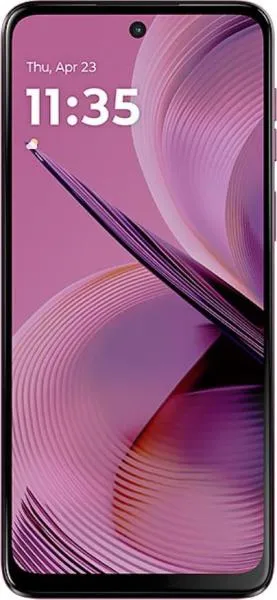
1. Specifications Comparison
| Feature | Samsung Galaxy A14 | Motorola Moto G55 | Practical Impact |
|---|---|---|---|
| Design | |||
| Dimensions (mm) | 167.7 x 78 x 9.1 | 161.6 x 73.8 x 8.1 | Moto G55 is slightly smaller and thinner, making it potentially more pocketable. |
| Weight (g) | 201 | 179 | Moto G55 is noticeably lighter, reducing hand fatigue during extended use. |
| Display | |||
| Size (inches) | 6.6 | 6.49 | Negligible difference in screen real estate. |
| Resolution (px) | 1080 x 2408 | 1080 x 2400 | Virtually identical resolution, resulting in similar sharpness. |
| Type | PLS LCD | IPS LCD | Both are LCD panels; PLS generally offers slightly better color reproduction and viewing angles than standard IPS, but real-world differences can be subtle. |
| Refresh Rate (Hz) | Not specified | 120 | The 120Hz refresh rate on the Moto G55 will provide a significantly smoother and more responsive user experience, especially noticeable in scrolling and gaming. |
| Performance | |||
| Chipset | Mediatek Helio G80 (12nm) | Mediatek Dimensity 7025 (6nm) | Dimensity 7025 utilizes a more advanced manufacturing process (6nm vs 12nm), leading to better performance and power efficiency. |
| CPU | Octa-core (2x2.0 GHz Cortex-A75 & 6x1.8 GHz Cortex-A55) | Octa-core (2x2.5 GHz Cortex-A78 & 6x2.0 GHz Cortex-A55) | Moto G55 has faster and more powerful CPU cores (Cortex-A78 vs A75), translating to significantly improved performance in demanding tasks and multitasking. |
| GPU | Mali-G52 MC2 | IMG BXM-8-256 | While specific benchmarks are missing, the IMG BXM-8-256 in the Moto G55 is generally considered more powerful, resulting in smoother gaming and graphics performance. |
| RAM | 4GB | 8GB | Double the RAM on the Moto G55 allows for more efficient multitasking and smoother performance with multiple apps open. |
| Camera | |||
| Rear Camera | 50MP Main, 2MP Macro, 2MP Depth | 50MP Main, 8MP Wide Angle | Moto G55 replaces the dedicated depth sensor with a more useful wide-angle lens, offering greater versatility in photography. |
| Front Camera | 13MP | 16MP | Moto G55 boasts a higher resolution front camera, potentially capturing more detailed selfies. |
| Video Recording | 1080p@30fps | 1080p@30/60fps | Moto G55 can record videos at 60fps, resulting in smoother footage. |
| Battery | |||
| Capacity (mAh) | 5000 | 5000 | Identical battery capacities suggest similar battery life, although real-world usage will depend on other factors like software optimization and display refresh rate. |
| Fast Charging | 15W | 30W | Moto G55 supports significantly faster charging, reducing downtime. |
2. Key Differences Analysis
Samsung Galaxy A14 Advantages:
- Potentially slightly better color reproduction: PLS display technology generally offers slightly better colors than standard IPS. However, this can be subjective and dependent on individual panel quality.
Motorola Moto G55 Advantages:
- Significantly smoother performance: More powerful processor, GPU, and double the RAM contribute to a noticeable difference in speed and responsiveness.
- Higher refresh rate display: 120Hz refresh rate provides a more fluid and enjoyable user experience.
- Faster charging: 30W fast charging significantly reduces charging times.
- More versatile camera system: Wide-angle lens offers more creative possibilities compared to a dedicated depth sensor.
- More recent OS: Android 14 offers potential performance and feature advantages over Android 13.
3. User Profiles & Recommendations
Samsung Galaxy A14:
- Ideal User: Budget-conscious users prioritizing basic smartphone functionality for everyday tasks like calling, texting, and web browsing. Users who are not demanding in terms of performance or gaming.
- Use Cases: Casual social media usage, light web browsing, basic photography.
Motorola Moto G55:
- Ideal User: Users seeking a well-rounded smartphone with smooth performance, a good display, and a versatile camera system. Users who engage in more demanding tasks, multitasking, or mobile gaming.
- Use Cases: Mobile gaming, demanding applications, multitasking, content creation (photography and video), consuming media.
4. Decision Framework
Key Questions for Buyers:
- What is your budget? The Moto G55 is likely more expensive.
- What is your primary use case? For basic tasks, the A14 may suffice. For demanding tasks or gaming, the G55 is strongly recommended.
- How important is display quality and smoothness? The G55's 120Hz refresh rate is a major advantage for a more enjoyable user experience.
Scenario-Based Recommendations:
- Tight budget and basic usage: Samsung Galaxy A14
- Balanced performance and value: Motorola Moto G55
My Choice: Motorola Moto G55
While the Samsung Galaxy A14 offers a lower price point, the Motorola Moto G55 provides significantly more value due to its superior performance, smoother display, faster charging, more versatile camera, and newer Android version. The difference in user experience would be substantial thanks to the faster processor, doubled RAM, and the 120Hz refresh rate screen. These features contribute significantly to a smoother and more enjoyable daily usage, justifying the likely price difference for most users. Unless budget is extremely tight, the Moto G55 is the clear winner.
