
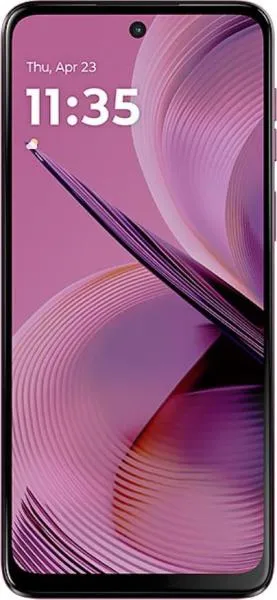
1. Specifications Comparison
| Feature | Apple iPhone 15 | Motorola Moto G55 | Practical Impact |
|---|---|---|---|
| Design | |||
| Dimensions | 147.6 x 71.6 x 7.8 mm | 161.6 x 73.8 x 8.1 mm | iPhone 15 is noticeably smaller and thinner, making it more pocketable and easier to handle one-handed. |
| Weight | 171g | 179g | The weight difference is minimal, unlikely to be noticeable in daily use. |
| Build Materials | Not specified | Not specified | Build quality and durability cannot be compared without further information. |
| Display | |||
| Display Type | Super Retina XDR OLED | IPS LCD | iPhone 15's OLED offers significantly better contrast, deeper blacks, and more vibrant colors. |
| Size | 6.1" | 6.49" | Moto G55 provides a larger viewing area, beneficial for media consumption and multitasking. |
| Resolution | 1179 x 2556 | 1080 x 2400 | iPhone 15 boasts a sharper display with higher pixel density (461 ppi vs 405 ppi), resulting in crisper text and images. |
| Refresh Rate | Not specified | 120Hz | Moto G55's 120Hz refresh rate delivers smoother scrolling and animations compared to a standard 60Hz likely on the iPhone (though not specified). |
| Peak Brightness | 2000 nits | Not specified | iPhone 15's superior peak brightness ensures excellent outdoor visibility. The lack of data for the Moto G55 prevents a direct comparison. |
| Performance | |||
| Chipset | Apple A16 Bionic (4 nm) | Mediatek Dimensity 7025 (6 nm) | A16 Bionic is generally considered a more powerful chipset, offering significantly better performance in demanding tasks and gaming. |
| CPU | Hexa-core (2x3.46 GHz + 4x2.02 GHz) | Octa-core (2x2.5 GHz + 6x2.0 GHz) | While core count differs, architecture and clock speeds suggest a performance advantage for the iPhone 15. |
| GPU | Apple GPU (5-core) | IMG BXM-8-256 | Specific GPU performance comparisons are difficult without benchmarks, but the A16's GPU is expected to be more capable. |
| RAM | 6GB | 8GB | While the Moto G55 has more RAM, iOS's memory management often allows iPhones to perform efficiently with less RAM. Real-world multitasking performance depends on optimization. |
| Storage | 256GB/512GB | 256GB | Both offer ample storage, but the iPhone 15 provides a 512GB option for users needing more space. |
| Camera | |||
| Rear Camera | Not specified | Not specified | Camera quality cannot be compared without sensor details, aperture, and other specifications. |
| Video | Up to 4K@60fps, 1080p@240fps | Up to 1080p@60fps | iPhone 15 offers higher resolution and frame rate video recording capabilities, including slow-motion at 240fps. |
| Battery | |||
| Capacity | 3349 mAh | 5000 mAh | Moto G55 has a significantly larger battery, likely translating to longer battery life. However, real-world usage varies depending on software and usage patterns. |
2. Key Differences Analysis
iPhone 15 Advantages:
- Superior Display: OLED technology, higher resolution, and greater peak brightness.
- Powerful Performance: A16 Bionic chip provides a significant performance advantage.
- More Compact Design: Smaller and thinner, easier for one-handed use.
- Advanced Video Recording: Higher resolution and frame rates.
Moto G55 Advantages:
- Larger Battery: Potentially longer battery life.
- Higher Refresh Rate Display: Smoother scrolling and animations.
- Larger Display: More immersive media consumption.
Trade-offs:
- iPhone 15: Smaller battery, potentially shorter battery life; higher price. Lack of specified refresh rate hinders comparison.
- Moto G55: Less powerful processor, lower resolution display; IPS LCD instead of OLED. Lack of brightness specifications hinders comparison.
3. User Profiles & Recommendations
iPhone 15: Users prioritizing performance, premium display quality, compact design, and a robust app ecosystem. Ideal for demanding tasks, gaming, content creation, and users who value a seamless user experience.
Moto G55: Users seeking a large battery, smooth display, and a more affordable option. Suitable for media consumption, casual gaming, and general everyday use.
4. Decision Framework
Key Questions:
- What is your budget? The iPhone 15 is typically more expensive.
- What are your performance needs? Demanding tasks and gaming favor the iPhone 15.
- What screen size and quality do you prefer? Larger screen and smooth scrolling favor the Moto G55, while superior image quality favors the iPhone 15.
My Choice:
I would choose the iPhone 15. While the Moto G55 offers a larger battery and higher refresh rate screen, the iPhone 15's superior processing power, vibrant OLED display, and compact form factor are more compelling to me. I prioritize a smooth and responsive user experience, high-quality visuals, and a device that can handle demanding tasks without lag. While battery life is important, I'm willing to compromise slightly in that area for the overall performance and premium experience offered by the iPhone 15. The lack of specific refresh rate data for the iPhone is a concern, but historically, even at 60Hz, iPhones have felt very fluid due to excellent software optimization.
